
AI-powered landing page: How to adapt your messages to sell in other countries
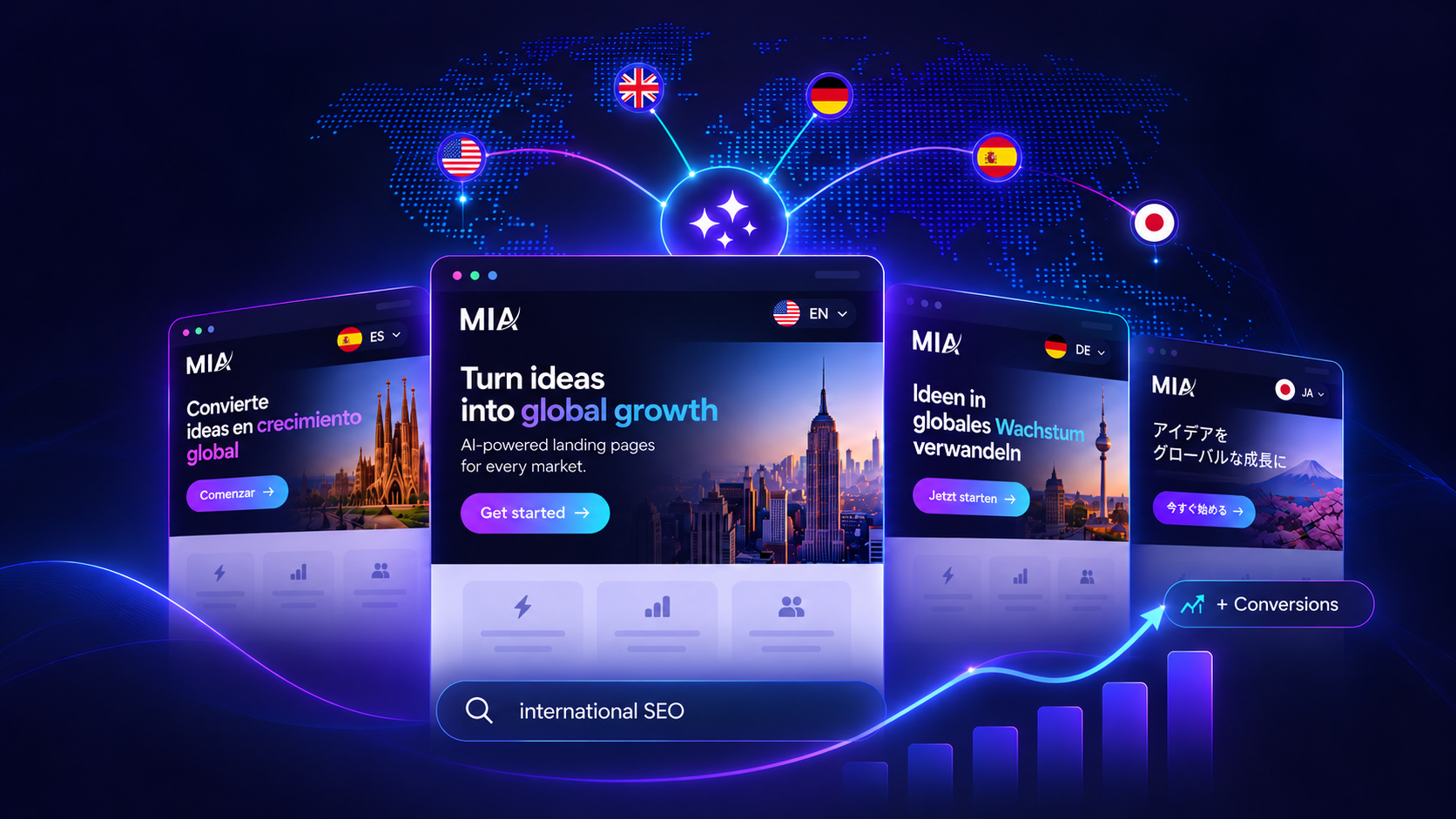
A landing page can work very well in Spain and fail when you replicate it in France, Germany, or Italy. The product is the same, the price barely changes, and the page is correctly translated. However, the user arrives, reads… and does not convert.
That scenario often leads to a wrong conclusion: "This market is not responding." In international projects, the problem is often not in the market, but in the fact that we have changed the language without changing the message. A landing page doesn't sell just because it's translated; It sells when it connects with the need, the way people search, and the objections of those who visit it.
Therefore, an AI-powered landing page should not be considered a quick way to produce multilingual versions. Its true value emerges when artificial intelligence is combined with market research, international SEO, cultural context, and conversion criteria to decide what should be maintained and what should be adapted.
Machine translation can be part of that process and provide large-scale speed. But a commercial landing page requires an additional question: not just "is it well translated?", but "is this the argument that can convince this market?". That's the difference between publishing content in another language and building a page ready to sell abroad.
Why a landing page that works in Spain might fail in another market
A landing page is a sequence of commercial decisions. The headline prioritizes a problem, the value proposition chooses a benefit, the intermediate blocks resolve objections, and the CTA asks for a concrete action. When we move to a different country, those decisions don't disappear: They then face a different context.
In a new market, the maturity of the category, the benchmark competitors, price sensitivity, service expectations, or the terminology with which the user describes their need can change. Even two countries that share a language can use different expressions or value different attributes.
In practice, this is clearly seen in SaaS, e-commerce, and B2B services. An argument like "easy to use" may work where the category still seems complex, but be irrelevant in another market where all competitors promise simplicity. There, it may be more effective to talk about integration, control, time savings, or return on investment.
The product has not changed. What changes is the gateway to its value. That nuance is central when using AI to adapt a landing page: Technology can generate alternatives quickly, but first we need to understand which hypotheses are worth generating.
Machine translation or AI-powered adaptation: they don't solve the same problem
Machine translation has improved remarkably and is now a common component in global content operations. It makes it possible to process volume, reduce turnaround times, and obtain a first version that is useful in many contexts. The mistake occurs when it becomes the sole criterion for a page whose objective is to persuade.
The data from CSA Research help us understand why language matters. In a survey of 8,709 consumers in 29 countries, 76% stated they prefer products with information in their own language and 40% said they would not buy from websites in other languages. The same study indicates that 66% use online machine translation, a sign of how much this technology is already part of everyday digital behavior.
But that data doesn't mean that translation is enough. Language removes a barrier to understanding; localization works on relevance. A person can perfectly understand a sentence and still not recognize their problem in it, not trust social proof, or not find the call to action convincing.
At MIA we work with this logic starting from adapting the content to the market. If you want to learn more, you can consult the guide on AI-powered localization for businesses in international markets, which explains how the approach varies according to the type of content and the sector.
What you need to adapt on an AI-powered landing page to sell in other countries
There's no need to rebuild each page from scratch. The important thing is to identify the elements that influence the decision. The first one is the main headline: In just a few seconds, it must confirm to the user that they have arrived at the right place and that the page understands their need.
Next comes the value proposition. Here it is important to separate features from benefits. A platform can maintain exactly the same functionalities in all its markets, but it does not necessarily have to present them in the same order or with the same commercial argument.
The hierarchy of objections also changes. In one country, demonstrating technical integration can be decisive; in another, providing clear information on security, returns, support, or implementation times. The page first needs to resolve the doubts that are really holding back the decision.
CTAs require the same consideration. "Buy now", "Try for free", "Request information" and "Book a demo" represent different levels of commitment. A well-known brand can afford to ask for a direct action. A company that has just entered the market may need to reduce friction and build trust first.
AI is especially useful because it allows you to generate multiple hypotheses for headlines, benefits, microcopy, FAQs, and CTAs without multiplying production time. But these alternatives must respond to a commercial hypothesis, not a simple exercise in style.
International SEO: research before writing
One of the most frequent mistakes in international expansion is translating the page first and looking for keywords afterwards. From an SEO point of view, the order should be the opposite: Before drafting, we need to know how the market formulates demand.
A keyword with good volume in Spain can have a perfectly correct translation and yet have minimal demand in France. It is also possible that there is an equivalent expression with a large volume but a different intention: informational in one country and clearly commercial in another.
That's why international keyword research is not about finding linguistic equivalents. It consists of identifying queries, SERPs, competitors, and local expectations. In MIA's guide on international SEO we develop three layers that are best worked on together: linguistic, semantic, and cultural.
Google also distinguishes between multilingual and multiregional sites. In its Google Search Central documentation, it recommends using different URLs for language versions and employing `hreflang` to help relate each variant to the appropriate language or region.
The technical layer that the copy cannot resolve
A landing page can have a great message and still not perform well if Google doesn't understand which version it should show. URL structure, indexability, canonicals and `hreflang` are all part of the same international strategy. Content does not make up for incorrect technical implementation, and technical implementation does not make up for an irrelevant page.
How to create a landing page with AI without generating generic content
The biggest risk of using artificial intelligence for copy is not that it will write badly. It’s that it writes something correct, clean, and completely interchangeable between brands. Phrases like "boost your business", "take your results to the next level" or "transform your growth" can appear in any sector and rarely explain why we should choose a specific company.
To avoid this, AI needs business context. Before generating, it is advisable to define positioning, product, audience, brand tone, terminology, allowed promises, priority arguments, and restrictions. Next, the market context is incorporated: competitors, searches, level of awareness, and main barriers.
MIA follows that logic of adaptation: it starts from the content and brand intent to work on the cultural context and international SEO. The MIA features page summarizes this approach in three phases: analysis of context and search intent, market adaptation, and SEO optimization.
Clarity remains one of the best conversion assets
Sophisticated technology does not change one basic rule: the user needs to quickly understand what we offer, why it matters to them, and what the next step is. This is especially important when the brand is not yet well-known in the new country.
The Unbounce Conversion Benchmark Report places the overall median conversion rate of the analyzed landing pages at 6.6%. Its methodology is based on over 464 million visitors, 57 million conversions, and more than 41,000 landing pages, so it offers a broad benchmark, although it should never be interpreted as a universal goal.
The same study finds a clear relationship between readability and conversion: Pages written at a reading level equivalent to grades 5–7 converted at 11.1%, compared to 5.3% for pages with professional-level language. It is an aggregate correlation, not a causal guarantee or a rule valid for all sectors, but it reinforces a very useful idea for internationalization: Making the message more difficult doesn't make it more convincing.
When adapting a landing page, we must preserve accuracy and personality, but eliminate unnecessary complexity. A sentence that sounds elegant in the original can become a cumbersome construction when translated. Editorial review remains key here, even when the first version comes from AI.
From automatic translation to a landing page tailored to each market
Let's imagine a business management platform whose Spanish landing page opens with "Manage your company easily". Machine translation can produce correct versions in multiple languages in seconds. But before publishing them, it is advisable to consider alternatives.
One version may emphasize productivity: "Reduce manual tasks and dedicate more time to growing your business". Another one may focus on control: "Centralize your processes and maintain control of your entire operation". A third one may focus on scalability: "Grow your business without multiplying the administrative burden".
None is better by definition. They are hypotheses. The decision should be supported by keyword research, competitor messaging, business data, and, where possible, A/B testing.
This is one of the most interesting uses of an AI-powered landing page: to reduce the cost of generating and reviewing alternatives so the team can learn faster. AI accelerates experimentation; The market decides which message wins.
The landing page as a tool to validate a new market
An international landing page is not only useful for converting traffic. It can also be used to validate an expansion hypothesis before committing to a larger investment.
Let's suppose a company is undecided between France and Germany. You can research demand, analyze competitors, select a value proposition for each country, and launch localized pages with controlled campaigns. Instead of deciding by intuition, start picking up real signals.
This approach turns localization into a learning tool. It allows you to discover which market best understands the proposal, what objections arise, and what arguments should be strengthened before scaling up.
How to measure if the adaptation is working
The conversion rate is an essential metric, but it shouldn't be read in isolation. A page can improve its conversion rate and, at the same time, attract less qualified traffic. That's why it's important to link behavior, acquisition, and business results.
In practice, I would review at least the CTR of campaigns or organic results, the conversion rate, the cost per lead, the quality of the lead, and the sales generated. It's also useful to observe scroll depth, CTA clicks, form abandonment, and the keywords that actually bring users to the page.
This cycle – research, adapt, publish, measure, and readjust – is where AI brings the most operational value. Not because it eliminates human judgment, but because it shortens the time between one hypothesis and the next.
Localization and search visibility with AI
International expansion is no longer solely about classic Google search results. Users also use generative tools to research brands, compare solutions, and resolve doubts before visiting a website.
A survey by Lokalise published in 2026 among 1,000 global marketing, SEO, and localization professionals found that 45% reported greater visibility in AI-powered searches in fully localized markets than in regions where they worked only in English. In addition, 63% stated that they were optimizing localized content for this type of search.
For a brand, the implication is clear. The better you describe your product, your category, and your proposition in the context of each country, the easier it will be for users and search systems to interpret its relevance. Localization thus goes from being a linguistic cost to becoming part of the discovery infrastructure.
AI-powered landing page: how to adapt the message to the search intent of each market
One of the most important differences between a local and an international landing page lies in the search intent.
Two users may be interested in the same solution, but be at different stages of the buying process. In one market, the search can be more informational; in another, more commercial or transactional.
Therefore, an AI-powered landing page should not adapt solely based on language. It should also address what the user expects to find when performing that search.
If the intent is informational, we may need to explain the problem better before presenting the product. If it's commercial, it's advisable to prioritize benefits, social proof, and differentiators. And if the intention is clearly transactional, the CTA can be more direct.
This analysis avoids one of the most common mistakes in internationalization: keeping the same message for users who arrive with different expectations.
Machine translation: what to check after publishing an international landing page
Machine translation can speed up the initial adaptation of a landing page, but the work doesn't end when the page is published.
From that moment on, it is necessary to check whether the message actually works in the new market.
It is important to analyze not only the conversion rate, but also how the user behaves on the page. If traffic arrives but doesn't progress, there may be a problem with the message. If the user scrolls but doesn't interact with the CTA, perhaps the value proposition isn't clear enough.
It's also important to review which terms are generating organic traffic. This allows you to check whether the page is ranking for the searches that really matter or whether Google is associating it with a different intent.
Machine translation helps to gain speed, but optimization must be based on real data. In an international strategy, publishing quickly is important; learning quickly is even more so.
This way you reinforce both keywords in H2 without repeating the exact same formula throughout the article.
MIA: adapt the message without losing brand identity
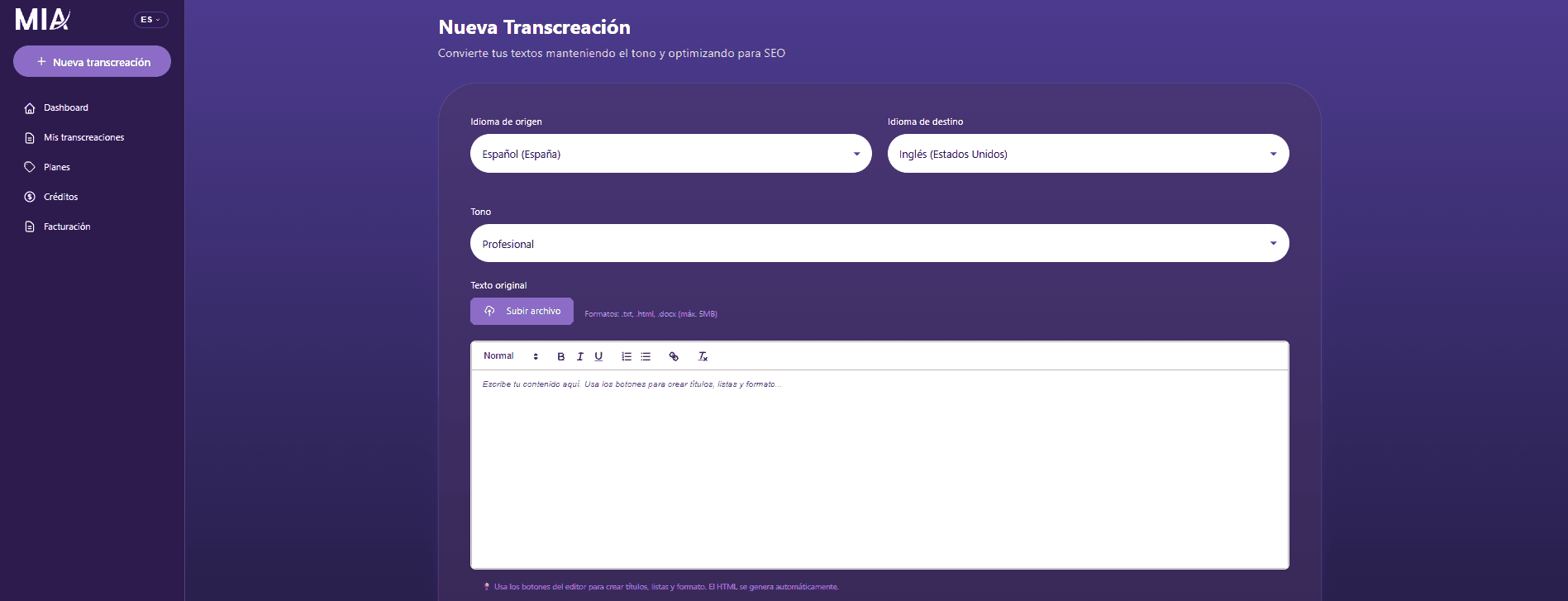
The difficulty of scaling international content is not just in producing more versions. It lies in ensuring they all maintain the same brand and, at the same time, seem written for real people in different markets.
MIA, developed by ATLS Global, combines localization with AI, cultural adaptation, and international SEO to help marketing teams work on that balance. The goal is not to replace a Spanish phrase with its literal equivalent, but to preserve the intention when it works and adapt the elements that determine its relevance.
On a landing page, this might mean keeping the core promise but changing the headline; retaining the same benefits, but rearranging them; or using another keyword because the direct translation does not represent local demand. In the guide on internationalization and localization of websites you can see how this approach is applied to a complete content flow.
AI makes the process scalable, but the criteria remain business-driven: what the user in this market should understand, value, and do when they arrive on the page.
How to make a page look like it was created for each market
A good international landing page shouldn't give the impression that you're reading a translated copy. It should feel natural in terms of terminology, tone, references, and decision flow.
The difference often lies in small details: an overly literal expression, a CTA that doesn't match local usage, a keyword that is hardly searched, an irrelevant testimonial, or a commercial condition that appears too late. None of those flaws destroy the page individually, but together they create distance.
Localization reduces that distance. And AI makes it possible to do this at a scale that previously required much more time, provided that the automation is supported by context, data, and review.
From machine translation to international conversion
Machine translation is an extraordinary tool for scaling content, but a page intended to attract business needs more than just linguistic equivalence. It needs a proposition capable of competing in the new context.
A well-designed AI-powered landing page combines production speed with market research, international SEO, brand identity, and conversion optimization. This combination makes it possible to maintain a global strategy without forcing all countries to respond to the same message.
The final question, therefore, is not whether we can translate a landing page in seconds. Today we can. The relevant question is whether that version deserves the attention and trust of the user we want to sell to.
Frequently asked questions about AI landing pages
What is an AI-powered landing page?
It is a landing page whose content is created, adapted, or optimized with the help of artificial intelligence. In an international context, AI can be used to develop alternative headlines, value propositions, CTAs, metadata, and sales arguments, provided that the process incorporates information about the market, the brand, and search intent.
Is machine translation enough to internationalize a landing page?
Not always. Machine translation can handle language transfer very well, but a business page must also respond to search intent, objections, and market expectations. For conversion content, it is advisable to combine translation, localization, and commercial optimization.
What is the difference between machine translation and AI-powered localization?
Machine translation focuses primarily on transferring content between languages. AI-powered localization incorporates cultural context, terminology, market, intent, brand identity, and business objective. In some cases, translation is sufficient; In others, especially landing pages and campaigns, the message needs to be reconstructed.
Should I use the same keywords in all countries?
No. Keywords should be researched for each market. A literal translation may have a different volume, respond to a different intent, or compete against a different type of result. International keyword research should be conducted before writing the final version of the landing page.
What should I measure after publishing an international landing page?
In addition to traffic and positions, it is advisable to analyze CTR, conversion, interaction with CTA, forms initiated and completed, cost per lead, quality of opportunities, and revenue. The analysis should be done by market to know where to scale and where to continue adjusting the message.
How do I know if an international landing page is working?
It is advisable to combine conversion rate with CTR, cost per lead, lead quality, on-page behavior, keywords that generate traffic, and actual sales. The appropriate metric depends on the business model; In B2B, the quality of the opportunity is often as important as the number of forms.