
Internationalization of companies: a practical guide to website localization
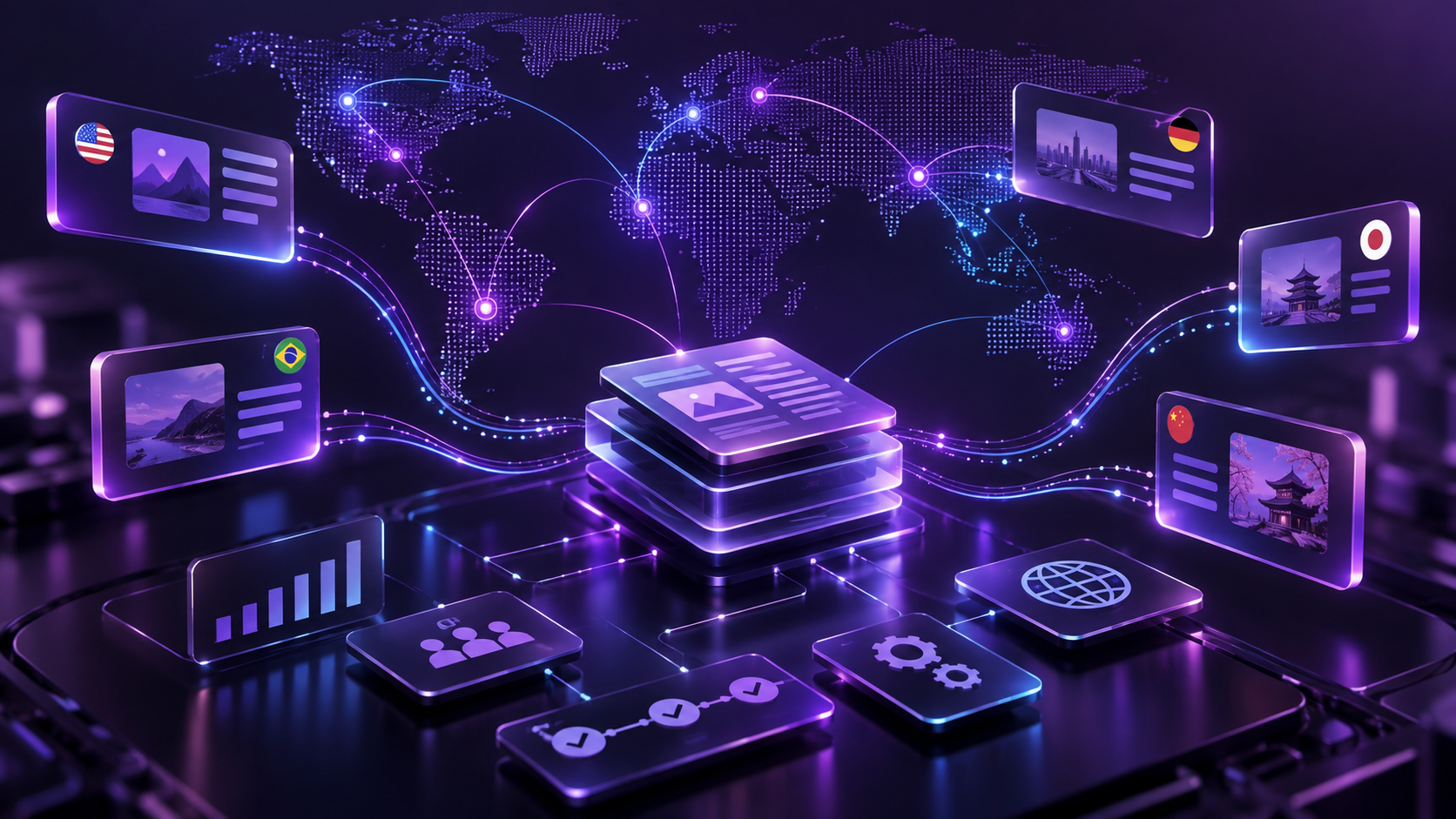
Entering a new market often seems simple on paper: select a country, translate the website, and start generating demand. However, when a company tries to repeat this process in multiple languages, the complexity grows rapidly.
Each new market adds keyword research, cultural adaptations, reviews, content versions, and coordination tasks. The marketing team begins managing scattered documents, external suppliers, and calendars that are moving at different speeds. Meanwhile, updating a global page requires reviewing all its international variants.
This is one of the main challenges of business internationalization. The problem is not just translating more content, but doing so quickly, consistently, and with local relevance, without multiplying costs or overloading the team.
Website localization must therefore become a scalable process. This involves combining strategy, International SEO, cultural adaptation, technology, and editorial control. Tools such as MIA allow this process to be accelerated through artificial intelligence, helping to transform original content into versions adapted to different languages and markets.
The challenge of internationalizing companies and localizing websites
International expansion introduces a tension that is difficult to resolve. On the one hand, the company needs to maintain its identity, its value proposition, and its core messages. On the other hand, each market demands content that seems created for its specific reality.
A literal translation can communicate the basic meaning of the text, but it does not guarantee that the page will respond to the searches, expectations, and objections of the local audience. The words used in Spain may not match those used in Mexico. An effective call to action in the UK may be too direct in another cultural environment. Even the way a price, a guarantee, or a success story is presented can influence trust.
The United States International Trade Administration differentiates between internationalization, regionalization, and localization. It defines localization as the adaptation of a website to target it specifically to a country and points out search engine optimization as part of the process necessary to reach international buyers. International Trade Administration
This means that a company doesn't just need multiple language versions. It needs relevant digital experiences for each market.
The problem arises when that customization depends entirely on manual processes. Localizing a page can be manageable. Localizing dozens of pages in five, ten, or twenty languages creates a very different workload. Without a proper system, each new market increases the time, cost, and likelihood of making mistakes.
Translation vs. website localization: What's the difference?
Translating a website and localizing it are not exactly the same thing. Translation transfers content from one language to another, while website localization adapts that content to the market, user behavior, and cultural context of the target country.
In a company's internationalization strategy, this difference is especially important. A page may be linguistically correct and yet not use the keywords that local users are searching for, present arguments that are not very relevant, or include calls to action that do not work the same way in that market.
Localization can affect vocabulary, tone, examples, units of measurement, cultural references, promotions, and also SEO.
For example, a company that wants to enter Germany should not limit itself to translating its Spanish content into German. Before publishing it, you should analyze how your audience searches, what terms they use, which competitors appear on Google, and which arguments generate the most trust.
Therefore, an effective localization strategy combines linguistic adaptation, international SEO, cultural context, and business objectives.
Why business internationalization stops scaling
Many organizations begin their international expansion with an improvised system. The team prepares the original text, sends it to a translator or provider, receives different files, and distributes them among marketing, SEO, and development.
This flow can work with little content, but it becomes difficult to manage as the volume increases. The main problems are usually the following.
Processes that are too slow
Each piece of content goes through numerous stages: extraction, translation, review, SEO optimization, approval, and implementation. If these tasks are performed consecutively and with different tools, publishing a campaign in multiple markets can take weeks.
The delay also affects updates. A change in the business proposal, the product, or the regulation requires localizing the related pages again. The more languages there are, the harder it is to keep all versions up to date.
Costs that increase with each language
In a completely manual model, each market adds hours of translation, coordination, review, and management. The cost increases almost in parallel with the number of versions.
This dynamic limits the ability to experiment. A company may forgo promising markets because it does not have the budget to produce all the necessary content, even if it does not yet know whether those markets will respond positively.
Overwhelmed marketing teams
Companies do not always have in-house specialists for every language. The core team ends up coordinating suppliers, resolving queries, and checking documents in languages they may not be fluent in.
The bottleneck is no longer in the strategy. It shifts towards production and coordination. Instead of analyzing results and improving campaigns, the team spends much of its time moving content between participants.
Inconsistencies in brand identity
When different providers work without a shared context, terminology, tone, and arguments can vary between markets. The result is a fragmented brand.
One version may communicate innovation, another may focus solely on price, and yet another may employ concepts that the company would never use in the original language. Although each text is correct on its own, the whole loses coherence.
Disconnection between translation and SEO
Translating a keyword is not the same as researching how a market searches. A linguistically correct expression may have a limited volume or respond to a different intention.
When optimization is done after translation, the SEO team may be forced to rewrite headings, metadata, and entire snippets. This creates duplication and further lengthens the process.
Common mistakes in the internationalization of companies and the localization of websites
A company's internationalization strategy can lose effectiveness if digital adaptation is limited to translating content. Website localization must take into account the market, search intent, and expectations of each audience. It is not enough to use the same keywords or replicate the same content in all countries, as each market searches, interprets, and responds differently.
Therefore, it is important to integrate localization with international SEO, adapt messages, tone, and calls to action, and analyze the results independently in each country. In addition, international versions must be kept up to date to reflect any changes in products, services, or brand messaging. In this way, localization becomes a strategic part of the internationalization process.
How to create a scalable website localization strategy
To scale, localization must no longer be managed as a collection of independent requests. It needs to function as a common system for producing, reviewing, approving, and updating international content.
The key is to separate strategic decisions from repetitive tasks.
The team must continue defining which markets have potential, which products it can offer, which audiences it wants to reach, and which value proposition is appropriate. The team must also validate the accuracy of sensitive content and verify that the final version correctly represents the brand.
However, some of the analysis and initial adaptation can be supported by automation. This makes it possible to generate versions more quickly and to focus human intervention on the points where it truly adds value.
A scalable model should include:
- Complete and approved original content.
- Clear information about the brand, the audience, and the objective.
- Keywords researched for each market.
- A common adaptation process.
- A view that allows you to compare the different versions.
- Review criteria based on content risk.
- Clearly designated individuals responsible for approval and publication.
- Metrics separated by language and country.
Not all content requires the same level of supervision. An educational blog post may undergo regular editorial review. A pricing page, a contract, or health-related content requires specialized controls.
Scaling does not mean eliminating human review, but using it in a proportionate and intelligent way.
International SEO and website localization: keys to entering new markets
Website localization must be accompanied by a strategy of international SEO. Adapting the language of a page does not guarantee that it can compete in the search results of the new market.
Before publishing an international version, it is advisable to analyze how the local user searches, which keywords they use, what their search intent is, and which competitors occupy the top positions.
An effective internationalization strategy for companies should work on at least four elements:
- Keyword research by country, avoiding literally transferring the keywords from the original market.
- Adaptation of titles, headings, and meta descriptions according to local search intent.
- Cultural localization of the content, adjusting arguments, expressions, examples, and calls to action.
- SEO measurement by market, analyzing positions, organic traffic, conversions, and the evolution of the localized pages.
In this way, the company does not simply create a website in several languages. It builds a digital presence ready to rank and compete in every new market.
How MIA solves the internationalization of companies and the localization of websites
MIA is a platform developed by ATLS Global to adapt digital content to different languages and markets. Its proposal combines transcreation using artificial intelligence and international SEO, so that the result is not limited to a word-for-word translation.
The tool organizes the process into a guided flow.
1. Incorporation of the original content
The user pastes into MIA the content they want to adapt. This could be a service page, an article, a business description, or other pre-prepared text.
According to the provided interface, each process supports content of between 1,000 and 5,000 characters. Working from a complete original text helps to preserve the context, objective, and main arguments during the adaptation.
2. Language selection
The team selects one or more target languages. The interface allows you to add new languages or remove those that are not needed before starting.
The platform communicates the ability to work with more than 50 languages. This allows you to prepare multiple versions from a single source, without manually repeating the workflow for each one.
Language is only one part of the decision. The team must indicate or be clear about which market it wants to target, because a version for Spain may need differences compared to one aimed at Mexico, even if both are written in Spanish.
3. Semantic analysis and SEO
At the start of the process, MIA analyzes the original content. The tool indicates that this analysis considers the semantic context, SEO, and keywords.
This phase allows us to interpret the purpose of the text before localizing it. Instead of replacing terms in isolation, the system works on the complete meaning and the elements that influence its organic performance.
For the team, this reduces the disconnect between translation and optimization. Both dimensions become part of the same adaptation flow.
4. Localization for each market.
After the analysis, MIA generates the versions corresponding to the selected languages. The platform uses transcreation to adapt the message to the new context without losing the intention of the original.
This is especially important on commercial pages. A benefit does not always have to be expressed in the same way in all countries. The localized version must retain the brand identity and, at the same time, feel natural to the new audience.
AI accelerates initial production. The team can dedicate more time to reviewing strategy, accuracy, and elements with the greatest commercial impact.
5. Comparison and editorial control
Once the process is complete, MIA displays the original content alongside the localized versions. The different languages appear organized in tabs, allowing you to switch between versions and compare them with the source.
This visualization offers a significant operational advantage. The team can check if essential messages have been preserved, review specific terms, and detect adjustments before publishing.
Localized content can also be edited from the interface. In this way, the AI's output does not automatically become a final version, but rather a basis over which the team maintains control.
6. Download and continuity of the process
After reviewing the content, the user can download it and continue with another piece. The flow is prepared to be repeated with new pages, articles, or materials.
This repeatability is fundamental for the internationalization of companies. The value lies not only in localizing content, but in having a method that can be consistently applied to an entire international strategy.
How to measure the success of an internationalization strategy
Process efficiency should be measured together with business performance. Producing more versions in less time adds value when those pages gain visibility, attract the right audience, and generate opportunities.
It is advisable to analyze each market separately using indicators such as:
- Average time for localization and publication.
- Cost per page and language.
- Percentage of content that needs corrections.
- Organic impressions and clicks.
- Keywords positioned by market.
- Leads and conversions.
- Revenue attributed to the localized pages.
- Performance of calls to action.
It is also important to collect qualitative information. Customer questions, sales objections, and identified terminological differences allow for improvements in subsequent versions.
Each market should function as a continuous cycle: research, localize, review, publish, measure, and optimize.
The internationalization of companies is not unlocked simply by adding languages to a website. It requires a system capable of maintaining local relevance, global coherence, and operational efficiency.
MIA offers a concrete solution to the content bottleneck. It analyzes the original, generates localized versions with an SEO focus, allows for comparison, and keeps the team in charge of editing and approval.
The result is a more agile way to approach website localization, test opportunities, and expand international presence without requiring resources to grow at the same pace as the markets.
Frequently asked questions about business internationalization and website localization
How does MIA help with business internationalization?
MIA analyzes original content, adapts it to the selected languages with an SEO focus, and allows you to compare, edit, and download each version.
What problems does MIA solve in business internationalization?
It reduces manual workload, speeds up production, improves consistency, and facilitates content creation for multiple markets.
Can MIA automate website localization in business internationalization?
MIA automates the analysis and initial adaptation. The team retains editorial control and must review the content according to its complexity and risk.
What content should be prioritized in business internationalization?
It's best to start with pages that combine local demand and commercial value, such as services, products, pricing, case studies, and content that already converts.
Why is SEO important for the internationalization of companies?
Because it allows you to understand how each market searches and adapt pages to terms and intents with real demand, beyond literal translation.
How does MIA help in the internationalization of companies?
MIA allows you to adapt content to different languages and markets by combining localization, AI-powered transcreation, and international SEO. The platform analyzes the original content, generates localized versions, and allows users to compare and edit them before publication.