
AI-powered email marketing: how to adapt your campaigns to different markets and increase conversions
An email campaign doesn't cease to be local just because you've translated it.. When a brand enters several countries, the challenge is not just changing words: You need to decide which sales argument to prioritize, what tone to use, what offer to show, what proof builds trust, and what call to action makes the most sense in each market.
That's where AI-powered email marketing can add value within an international marketing strategy: It allows you to work from a master campaign and generate localized versions more quickly, provided there is a clear methodology and a review that avoids literal translations, cultural clichés, or messages disconnected from the market.
The key idea of this article is simple: Localization is not translation. Localization is about maintaining the business objective of a campaign and adapting the way that objective is communicated so that it is relevant in each country.
Email marketing with AI and international marketing: why localizing a campaign is much more than translating
A translation answers the question "How do I say this in another language?". Localization answers another question that is more useful for business: "How should I communicate this offer so that it makes sense in this market?".
- In an international campaign, it is advisable to review, at a minimum:
- The subject line and the preheader: they must capture attention naturally in the language and context of the market.
- The value proposition: not all audiences prioritize the same benefits or react the same way to the same arguments.
- The tone: more direct, more descriptive, more technical or more aspirational depending on the brand, the category and the market.
- The offer: price, currency, discounts, shipping costs, purchase thresholds and promotional conditions.
- The trust test: reviews, ingredients, certifications, returns, delivery, warranty or brand reputation.
- The CTA: It should sound natural and correspond to the user's decision phase.
- The experience after the click: Landing page, language, currency, catalog, availability, and checkout must continue the promise of the email.
What AI-powered email marketing contributes to localization in international marketing
AI does not replace the localization strategy. It speeds it up. It can help generate variations, adapt length and tone, detect unnatural expressions, propose alternative CTAs, or rewrite a message from a new angle. But it needs a market brief.
A good brief for localizing a campaign should contain:
- Target market and language.
- Audience profile and level of brand awareness.
- Campaign objective: sale, launch, reactivation, acquisition, etc.
- Product benefits that can be communicated and claims that should not be invented.
- Brand tone and words that should be maintained.
- Local offer and conditions.
- Message hypothesis that we want to validate in that country.
- Output format: subject, preheader, hero, body, CTA and A/B alternative.
In international marketing, AI works better as an "adaptation engine" than as an "automatic copy generator."
Case study: A cosmetics brand launches the same serum in Spain, France and Germany
Cosmetics have a presence in European e-commerce. According to the Eurostat data on online purchases, in 2024, 31% of people in the European Union who had shopped online in the previous three months purchased cosmetics. We start from this context to show how a brand could adapt a campaign to three markets without changing the product or inventing new promises.
This case is fictitious and serves to illustrate the process. Differences between markets are presented as hypotheses to be investigated and validated with data, not as cultural stereotypes.
| Brand | Nébula Skin, a Spanish cosmetics brand with a mid-to-premium positioning. |
| Product | Daily moisturizing facial serum, light texture, 30 ml. |
| Objective | Get first purchases in three markets without creating three campaigns from scratch. |
| Offer | 15% launch discount for 72 hours. Terms and currency adapted by market. |
| Base campaign | A master campaign in Spanish with product information, main benefit, offer and CTA. |
Subject: Your new hydrating serum is 15% off
Preheader: A lightweight formula for everyday use.
Hero: Daily hydration, without complications.
CTA: Buy now
The campaign is correct, but it hasn't been localized yet. If we translate it literally into French and German, we will have three languages, not necessarily three adapted campaigns.
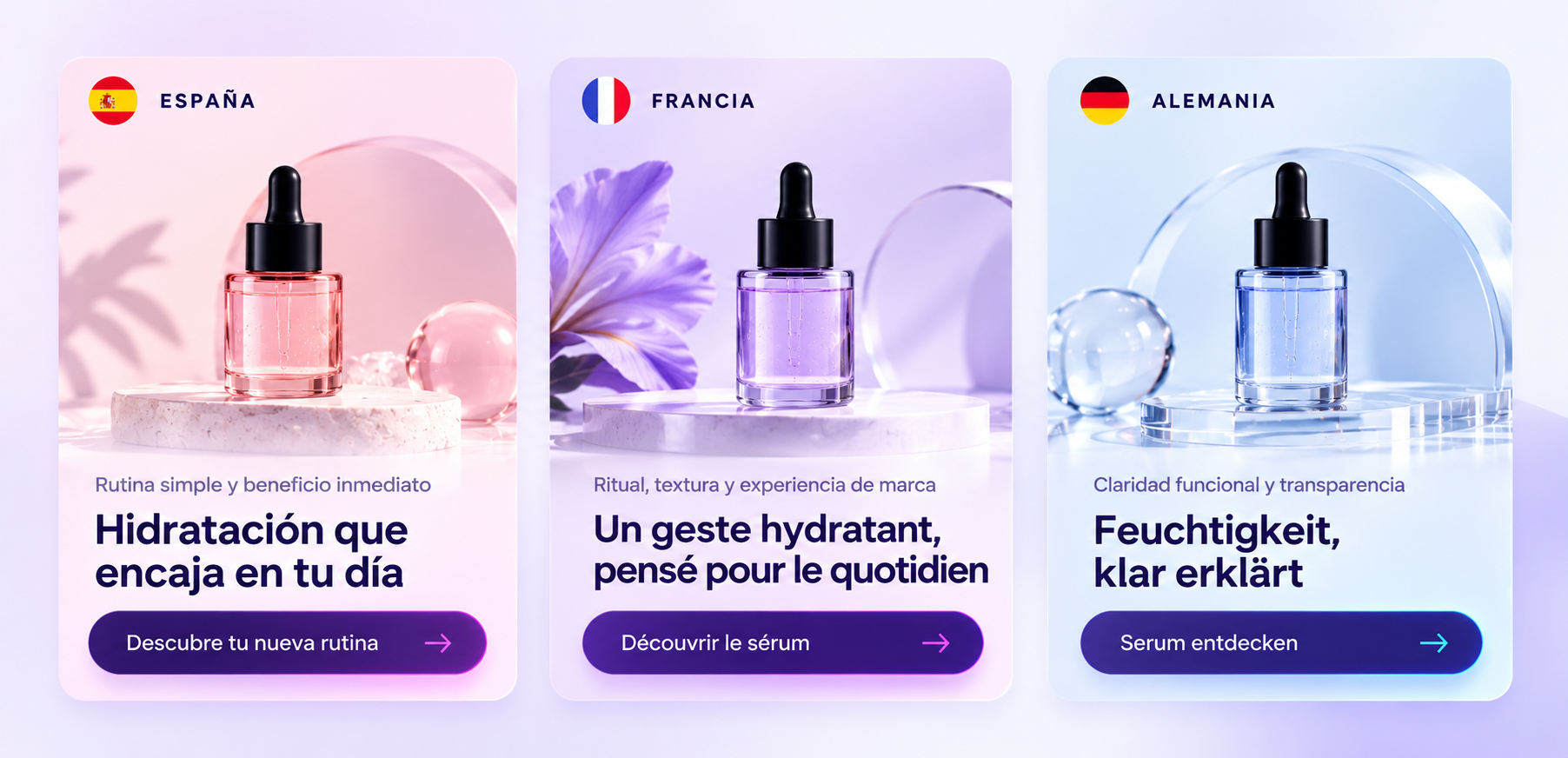
AI-powered email marketing in Spain: localize the message to simplify the routine
Working hypothesis: For this specific segment, the campaign can test a simple, everyday message, with a benefit that is understandable from the first impact. We do not assume that "Spain buys like this"; We define a hypothesis that we will then measure.
Subject: Your skin needs hydration. Your routine doesn't need to get complicated.
Preheader: A lightweight serum to use every morning and every night.
Hero: Hydration that fits into your day.
Body: A lightweight texture, a simple step, and a 15% launch discount for 72 hours.
CTA: Discover your new routine
What has been localized: The prominence of technical language is reduced, and the focus is placed on ease of use, routine and immediate benefit. The offer appears early and the CTA avoids sounding overly aggressive.
France: strengthen product experience and brand perception
Working hypothesis: In this French segment we want to test whether a more sensory and editorial narrative improves the response compared to a purely functional version. The product does not change; changes the message hierarchy.
Subject: A new gesture of hydration for your everyday life
Preheader: A light texture, designed to accompany your routine.
Hero: Un geste de soin, chaque jour.
Body: A light formula that is easy to integrate into your routine, with -15% for 72 hours for its launch.
CTA: Discover the serum
What has been localized: The campaign places less emphasis on "buy now" and more on discovery, ritual, and experience. The language becomes more editorial without introducing new claims or changing the product promise.
Germany: prioritize clarity, information, and control of the promise
Working hypothesis: For this audience, we want to test a more explicit and functional version, where the user quickly understands what the product is, how it fits into their routine, and what the promotion is.
Betreff: Daily moisture. Klar in der Anwendung.
Preheader: Leichtes Serum für deine tägliche Pflegeroutine.
Hero: Feuchtigkeit, klar erklärt.
Body: Leichte Textur für die tägliche Anwendung. Zum Launch erhältst du 72 Stunden lang 15 % Rabatt.
CTA: Discover serum
What has been localized: Aspirational language is reduced, information is organized, and the relationship between product, use, and offer is made explicit. Again, this is a communication hypothesis that needs to be validated with market data.
International marketing and localization: The difference lies not in the language, but in the editorial decision
| Element | Spain | France | Germany |
| Angle | Simplicity and routine | Experience and discovery | Clarity and function |
| Priority benefit | Easy to integrate | Care experience | Clear use and proposition |
| CTA | Discover your new routine | Discover the serum | Discover serum |
| What to test | Benefit vs. discount | Editorial vs. functional | Brief information vs. detailed |
How to localize an AI-powered email marketing campaign for different international markets
1. Define a master campaignBefore using AI, define your objective, offer, product facts, brand tone, and main CTA. The master campaign is the common reference point.
2. Research each marketAnalyze competitors, language used in the category, objections, common promises, business calendar, applicable regulations, and service expectations.
3. Formulate hypotheses, not stereotypesLocalization starts with questions that can be validated: Does a more functional message work better? Should the discount appear in the subject line? What proof of trust does this audience need?
4. Use AI-powered email marketing to generate variationsRequest market-controlled versions: subject, preheader, hero, body, and CTA. The AI must respect the product's facts and explain what it has adapted.
5. Connect email and destinationLocalization fails if the email is in French but the landing page, price, or checkout page are not. The experience must continue after the click.
6. Measure by marketDon't compare countries as if they were the same segment. Compare variations within each market and learn what factors explain the improvement.
5. What to measure to know if the localization is working
The open rate can serve as a secondary signal, but localization should be evaluated primarily in terms of behavior and business. Mailchimp has observed that segmented campaigns achieve more interaction than non-segmented ones, and its analyses link the relevance of the message with better results. HubSpot also places segmentation and personalization among the most effective uses of email marketing.
- CTR by version and market.
- Conversion rate after the click.
- Revenue per recipient or per send.
- Average order value where applicable.
- Cancellations and complaints: a sign of lack of relevance.
- Subject line, hero, and CTA performance through A/B testing.
- Consistency between the localized version of the email and the destination landing page.
To identify which version drives visits to the website, tag the links with campaign parameters in Google Analytics. In this practical case, we can use utm_campaign to identify the launch and utm_content to distinguish variants such as fr_editorial or fr_funcional. This will allow us to analyze separately the traffic coming from each approach, provided that the website measurement is correctly configured.
Example of a correct test: in France, compare an editorial version versus a functional one while maintaining offer, audience and delivery time. The goal is to isolate the effect of the communication approach, not to compare France against Germany.
AI-powered email marketing in international marketing: how to maintain brand identity in different markets
One of the main challenges of international marketing is adapting communication without making the brand seem different in each country. Good localization should not transform the company’s personality, but rather find the most appropriate way to express it in each context.
Here AI-powered email marketing can be especially useful. Working from a master campaign allows you to establish a common reference point for tone, message, value proposition, and objectives. From that base, versions adapted to different markets can be created without losing the elements that make the brand recognizable.
For example, a brand can always maintain a friendly tone, be visually clean and focused on concrete benefits, but adapt the way those benefits are presented. In one market, it may be more effective to develop the argument in a more descriptive way; In another, use shorter and more direct messages. Adaptation changes the execution, not the essence.
So that AI-powered email marketing maintains that consistency, it is advisable to define brand rules beforehand: Expressions that must be preserved, terms that must not be used, permitted claims, level of formality, message structure, and elements that must never be modified.
This is especially important when an international marketing strategy begins to expand to several countries. Without clear rules, each new campaign can deviate slightly from the original positioning, resulting in fragmented communication.
AI should therefore be used as a tool to expand the team's capabilities without losing control over the content. The goal is not to create a different voice for each market, but to ensure that the same brand feels natural, consistent, and relevant in all of them.
Localization errors in AI-powered email marketing for international markets
Translate word by word: The result may be grammatically correct but commercially unconvincing.
Changing the tone without a hypothesis: Localizing does not mean "making it more creative"; Every change must respond to a market reason.
Inventing claims with AI: AI can reframe facts, but it should not create benefits, certifications, or features that the product does not have.
Maintain the same offer in all countries: Currency, shipping, thresholds, dates and conditions can cause a campaign to lose relevance.
Forgetting the landing: The user does not perceive localization as an isolated piece. Email, web and checkout form a single experience.
Using cultural clichés: "Germans are rational" or "the French are aspirational" is not a strategy. These are simplifications that should be replaced by research and testing.
Email marketing with AI and international marketing: personalization and localization are not the same thing
In an AI-powered email marketing strategy, personalizing and localizing a campaign are two different processes. Personalization adapts the message to user characteristics, such as their behavior, interests, purchase history, or the stage of the funnel they are in. Localization, on the other hand, adapts the campaign to the market context: language, cultural references, commercial arguments, offer, currency, service expectations and way of presenting the product.
This difference is especially important in international marketing. A campaign can be perfectly personalized for a repeat customer and, at the same time, be poorly localized if it uses an unnatural tone, displays a promotion that does not correspond to their country, or directs the user to a shopping experience designed for another market.
The true potential of email marketing with AI appears when both layers are combined. A brand can start with a global campaign, localize it for France, and within that French version, create different messages for new users, repeat customers, or inactive buyers. Adaptation then ceases to be carried out solely by language and begins to respond to both the market and the customer’s moment.
In international marketing, this combination helps avoid one of the most frequent mistakes in global campaigns: treat all users in a country as a single group. The market provides context, but individual behavior remains relevant. The strategy must decide which elements depend on the country and which depend on the relationship that each person maintains with the brand.
Therefore, using AI-powered email marketing should not mean generating a single version per language. AI can help build different combinations of market, audience, and funnel stage, provided there is a prior strategy that determines what needs to change and why.
How to adapt the customer journey to each market
The localization of a campaign should not be analyzed as an isolated action. As part of an international marketing strategy, the user may receive different emails before making a purchase: welcome, product presentation, cart recovery, launch, promotion, after-sales service, or reactivation. They are all part of the same customer journey and should maintain consistent logic within each market.
AI-powered email marketing allows you to adapt that journey without having to build each international sequence from scratch. A company can first define the global journey and then localize each touchpoint by country, maintaining the commercial objective but adapting how it is communicated.
For example, the first email in a sequence can focus on building trust, the second on explaining the product, and the third on driving conversion. That structure can be maintained in Spain, France and Germany, but the hierarchy of the arguments, the level of detail, the confidence tests or the way of presenting the CTA can vary depending on the hypotheses that are to be validated in each market.
In international marketing, this perspective is more useful than translating emails one by one, because it allows you to analyze the entire experience. If a brand adapts a product launch but leaves abandoned cart or after-sales emails untranslated, the user receives messages with different levels of adaptation and the experience loses consistency.
AI-powered email marketing can help scale these sequences, while maintaining brand guidelines and generating variations for each market. In this way, localization ceases to be a one-off task and becomes a permanent layer of the CRM and automation strategy.
For a company that operates in multiple countries, the goal shouldn't be to have more translated emails, but to build journeys that seem specifically designed for each market.
International marketing and email marketing with AI: how to turn each campaign into knowledge about the market
One of the biggest advantages of AI-powered email marketing within an international marketing strategy is that every campaign can become a source of learning. Localization is not just about creating a different version for each country, but also about using the results to understand which messages, benefits, and arguments work best in each market.
The Nébula Skin case makes this clear. If in France an editorial version is compared with a more functional one, the test result provides information that can be used in subsequent campaigns. If in Germany a version that clearly explains the use of the product performs better than one focused on the discount, that information can also be incorporated into future content decisions.
Thus, AI-powered email marketing allows for iterative work. The first version is based on a hypothesis; the data shows how the user responds; and the next campaign uses that learning to improve the message.
Within international marketing, this process has special value because it reduces dependence on cultural intuitions or generalizations. Instead of assuming how a brand should communicate in a country, the team progressively builds its own knowledge about that market.
Over time, a company can create a country-specific learning base that gathers which topics generate the most clicks, which benefits spark the most interest, which CTAs work best, which promotions convert, and which arguments build trust. This information can then be used to improve new campaigns, product pages, ads, or commercial content.
AI accelerates the generation of variants, but data determines which version deserves to be kept. Therefore, a mature AI-powered email marketing strategy should combine generation, localization, experimentation, and continuous learning.
The result is an international marketing strategy that is increasingly less based on assumptions and more supported by the actual behavior of each market.
How MIA fits into an international marketing strategy
The value of a solution like MIA should not be explained as "translating emails with AI". The most distinctive positioning is helping marketing teams work on adapting content for different markets with more expertise and less manual work.
Applied to email marketing with AI, the ideal flow would be: master campaign → market context → message adaptation → review → test → learning. In this way, the team maintains the global brand strategy, but avoids sending exactly the same campaign to all countries.
Key idea for closing: An international campaign should not seem translated. It should seem as if it was created for the person who receives it.
Frequently asked questions about email marketing with AI and international marketing
AI-powered email marketing: what is the difference between translating and localizing a campaign?
Translating changes the language. Localize to adapt the message to the market: tone, priority benefit, offer, CTA, references, currency, trust signal, and post-click experience.
AI-powered email marketing: Can it localize a campaign automatically?
It can speed up the creation of variants and detect adaptation opportunities, but it needs market context, brand boundaries, and review. Automating without context increases the risk of generic or unnatural messages.
International marketing: Which parts of an email should be adapted for each country?
Subject, preheader, hero, sales pitch, body, offer, CTA, images when they provide context, currency, conditions and destination landing page.
International marketing: How can you tell if a localized version works better?
Using A/B testing within the same market and measuring clicks, conversion, revenue, and churn. The comparison should keep offer, audience, and send time constant whenever possible.
How does AI-powered email marketing help an international marketing strategy?
Yes, especially for scaling campaign adaptation and generating market-specific variations, provided that AI works on a localization strategy and does not replace local research or review.