AI-powered landing page: How to adapt your messages to sell in other countries
A landing page can work very well in Spain and fail when you replicate it in France, Germany, or Italy. The product is the same, the price barely changes, and the page is correctly translated. However, the user arrives, reads… and does not convert.
That scenario often leads to a wrong conclusion: "This market is not responding." In international projects, the problem is often not in the market, but in the fact that we have changed the language without changing the message. A landing page doesn't sell just because it's translated; It sells when it connects with the need, the way people search, and the objections of those who visit it.
Therefore, an AI-powered landing page should not be considered a quick way to produce multilingual versions. Its true value emerges when artificial intelligence is combined with market research, international SEO, cultural context, and conversion criteria to decide what should be maintained and what should be adapted.
Machine translation can be part of that process and provide large-scale speed. But a commercial landing page requires an additional question: not just "is it well translated?", but "is this the argument that can convince this market?". That's the difference between publishing content in another language and building a page ready to sell abroad.
Why a landing page that works in Spain might fail in another market
A landing page is a sequence of commercial decisions. The headline prioritizes a problem, the value proposition chooses a benefit, the intermediate blocks resolve objections, and the CTA asks for a concrete action. When we move to a different country, those decisions don't disappear: They then face a different context.
In a new market, the maturity of the category, the benchmark competitors, price sensitivity, service expectations, or the terminology with which the user describes their need can change. Even two countries that share a language can use different expressions or value different attributes.
In practice, this is clearly seen in SaaS, e-commerce, and B2B services. An argument like "easy to use" may work where the category still seems complex, but be irrelevant in another market where all competitors promise simplicity. There, it may be more effective to talk about integration, control, time savings, or return on investment.
The product has not changed. What changes is the gateway to its value. That nuance is central when using AI to adapt a landing page: Technology can generate alternatives quickly, but first we need to understand which hypotheses are worth generating.
Machine translation or AI-powered adaptation: they don't solve the same problem
Machine translation has improved remarkably and is now a common component in global content operations. It makes it possible to process volume, reduce turnaround times, and obtain a first version that is useful in many contexts. The mistake occurs when it becomes the sole criterion for a page whose objective is to persuade.
The data from CSA Research help us understand why language matters. In a survey of 8,709 consumers in 29 countries, 76% stated they prefer products with information in their own language and 40% said they would not buy from websites in other languages. The same study indicates that 66% use online machine translation, a sign of how much this technology is already part of everyday digital behavior.
But that data doesn't mean that translation is enough. Language removes a barrier to understanding; localization works on relevance. A person can perfectly understand a sentence and still not recognize their problem in it, not trust social proof, or not find the call to action convincing.
At MIA we work with this logic starting from adapting the content to the market. If you want to learn more, you can consult the guide on AI-powered localization for businesses in international markets, which explains how the approach varies according to the type of content and the sector.
What you need to adapt on an AI-powered landing page to sell in other countries
There's no need to rebuild each page from scratch. The important thing is to identify the elements that influence the decision. The first one is the main headline: In just a few seconds, it must confirm to the user that they have arrived at the right place and that the page understands their need.
Next comes the value proposition. Here it is important to separate features from benefits. A platform can maintain exactly the same functionalities in all its markets, but it does not necessarily have to present them in the same order or with the same commercial argument.
The hierarchy of objections also changes. In one country, demonstrating technical integration can be decisive; in another, providing clear information on security, returns, support, or implementation times. The page first needs to resolve the doubts that are really holding back the decision.
CTAs require the same consideration. "Buy now", "Try for free", "Request information" and "Book a demo" represent different levels of commitment. A well-known brand can afford to ask for a direct action. A company that has just entered the market may need to reduce friction and build trust first.
AI is especially useful because it allows you to generate multiple hypotheses for headlines, benefits, microcopy, FAQs, and CTAs without multiplying production time. But these alternatives must respond to a commercial hypothesis, not a simple exercise in style.
International SEO: research before writing
One of the most frequent mistakes in international expansion is translating the page first and looking for keywords afterwards. From an SEO point of view, the order should be the opposite: Before drafting, we need to know how the market formulates demand.
A keyword with good volume in Spain can have a perfectly correct translation and yet have minimal demand in France. It is also possible that there is an equivalent expression with a large volume but a different intention: informational in one country and clearly commercial in another.
That's why international keyword research is not about finding linguistic equivalents. It consists of identifying queries, SERPs, competitors, and local expectations. In MIA's guide on international SEO we develop three layers that are best worked on together: linguistic, semantic, and cultural.
Google also distinguishes between multilingual and multiregional sites. In its Google Search Central documentation, it recommends using different URLs for language versions and employing `hreflang` to help relate each variant to the appropriate language or region.
The technical layer that the copy cannot resolve
A landing page can have a great message and still not perform well if Google doesn't understand which version it should show. URL structure, indexability, canonicals and `hreflang` are all part of the same international strategy. Content does not make up for incorrect technical implementation, and technical implementation does not make up for an irrelevant page.
How to create a landing page with AI without generating generic content
The biggest risk of using artificial intelligence for copy is not that it will write badly. It’s that it writes something correct, clean, and completely interchangeable between brands. Phrases like "boost your business", "take your results to the next level" or "transform your growth" can appear in any sector and rarely explain why we should choose a specific company.
To avoid this, AI needs business context. Before generating, it is advisable to define positioning, product, audience, brand tone, terminology, allowed promises, priority arguments, and restrictions. Next, the market context is incorporated: competitors, searches, level of awareness, and main barriers.
MIA follows that logic of adaptation: it starts from the content and brand intent to work on the cultural context and international SEO. The MIA features page summarizes this approach in three phases: analysis of context and search intent, market adaptation, and SEO optimization.
Clarity remains one of the best conversion assets
Sophisticated technology does not change one basic rule: the user needs to quickly understand what we offer, why it matters to them, and what the next step is. This is especially important when the brand is not yet well-known in the new country.
The Unbounce Conversion Benchmark Report places the overall median conversion rate of the analyzed landing pages at 6.6%. Its methodology is based on over 464 million visitors, 57 million conversions, and more than 41,000 landing pages, so it offers a broad benchmark, although it should never be interpreted as a universal goal.
The same study finds a clear relationship between readability and conversion: Pages written at a reading level equivalent to grades 5–7 converted at 11.1%, compared to 5.3% for pages with professional-level language. It is an aggregate correlation, not a causal guarantee or a rule valid for all sectors, but it reinforces a very useful idea for internationalization: Making the message more difficult doesn't make it more convincing.
When adapting a landing page, we must preserve accuracy and personality, but eliminate unnecessary complexity. A sentence that sounds elegant in the original can become a cumbersome construction when translated. Editorial review remains key here, even when the first version comes from AI.
From automatic translation to a landing page tailored to each market
Let's imagine a business management platform whose Spanish landing page opens with "Manage your company easily". Machine translation can produce correct versions in multiple languages in seconds. But before publishing them, it is advisable to consider alternatives.
One version may emphasize productivity: "Reduce manual tasks and dedicate more time to growing your business". Another one may focus on control: "Centralize your processes and maintain control of your entire operation". A third one may focus on scalability: "Grow your business without multiplying the administrative burden".
None is better by definition. They are hypotheses. The decision should be supported by keyword research, competitor messaging, business data, and, where possible, A/B testing.
This is one of the most interesting uses of an AI-powered landing page: to reduce the cost of generating and reviewing alternatives so the team can learn faster. AI accelerates experimentation; The market decides which message wins.
The landing page as a tool to validate a new market
An international landing page is not only useful for converting traffic. It can also be used to validate an expansion hypothesis before committing to a larger investment.
Let's suppose a company is undecided between France and Germany. You can research demand, analyze competitors, select a value proposition for each country, and launch localized pages with controlled campaigns. Instead of deciding by intuition, start picking up real signals.
This approach turns localization into a learning tool. It allows you to discover which market best understands the proposal, what objections arise, and what arguments should be strengthened before scaling up.
How to measure if the adaptation is working
The conversion rate is an essential metric, but it shouldn't be read in isolation. A page can improve its conversion rate and, at the same time, attract less qualified traffic. That's why it's important to link behavior, acquisition, and business results.
In practice, I would review at least the CTR of campaigns or organic results, the conversion rate, the cost per lead, the quality of the lead, and the sales generated. It's also useful to observe scroll depth, CTA clicks, form abandonment, and the keywords that actually bring users to the page.
This cycle – research, adapt, publish, measure, and readjust – is where AI brings the most operational value. Not because it eliminates human judgment, but because it shortens the time between one hypothesis and the next.
Localization and search visibility with AI
International expansion is no longer solely about classic Google search results. Users also use generative tools to research brands, compare solutions, and resolve doubts before visiting a website.
A survey by Lokalise published in 2026 among 1,000 global marketing, SEO, and localization professionals found that 45% reported greater visibility in AI-powered searches in fully localized markets than in regions where they worked only in English. In addition, 63% stated that they were optimizing localized content for this type of search.
For a brand, the implication is clear. The better you describe your product, your category, and your proposition in the context of each country, the easier it will be for users and search systems to interpret its relevance. Localization thus goes from being a linguistic cost to becoming part of the discovery infrastructure.
AI-powered landing page: how to adapt the message to the search intent of each market
One of the most important differences between a local and an international landing page lies in the search intent.
Two users may be interested in the same solution, but be at different stages of the buying process. In one market, the search can be more informational; in another, more commercial or transactional.
Therefore, an AI-powered landing page should not adapt solely based on language. It should also address what the user expects to find when performing that search.
If the intent is informational, we may need to explain the problem better before presenting the product. If it's commercial, it's advisable to prioritize benefits, social proof, and differentiators. And if the intention is clearly transactional, the CTA can be more direct.
This analysis avoids one of the most common mistakes in internationalization: keeping the same message for users who arrive with different expectations.
Machine translation: what to check after publishing an international landing page
Machine translation can speed up the initial adaptation of a landing page, but the work doesn't end when the page is published.
From that moment on, it is necessary to check whether the message actually works in the new market.
It is important to analyze not only the conversion rate, but also how the user behaves on the page. If traffic arrives but doesn't progress, there may be a problem with the message. If the user scrolls but doesn't interact with the CTA, perhaps the value proposition isn't clear enough.
It's also important to review which terms are generating organic traffic. This allows you to check whether the page is ranking for the searches that really matter or whether Google is associating it with a different intent.
Machine translation helps to gain speed, but optimization must be based on real data. In an international strategy, publishing quickly is important; learning quickly is even more so.
This way you reinforce both keywords in H2 without repeating the exact same formula throughout the article.
MIA: adapt the message without losing brand identity
The difficulty of scaling international content is not just in producing more versions. It lies in ensuring they all maintain the same brand and, at the same time, seem written for real people in different markets.
MIA, developed by ATLS Global, combines localization with AI, cultural adaptation, and international SEO to help marketing teams work on that balance. The goal is not to replace a Spanish phrase with its literal equivalent, but to preserve the intention when it works and adapt the elements that determine its relevance.
On a landing page, this might mean keeping the core promise but changing the headline; retaining the same benefits, but rearranging them; or using another keyword because the direct translation does not represent local demand. In the guide on internationalization and localization of websites you can see how this approach is applied to a complete content flow.
AI makes the process scalable, but the criteria remain business-driven: what the user in this market should understand, value, and do when they arrive on the page.
How to make a page look like it was created for each market
A good international landing page shouldn't give the impression that you're reading a translated copy. It should feel natural in terms of terminology, tone, references, and decision flow.
The difference often lies in small details: an overly literal expression, a CTA that doesn't match local usage, a keyword that is hardly searched, an irrelevant testimonial, or a commercial condition that appears too late. None of those flaws destroy the page individually, but together they create distance.
Localization reduces that distance. And AI makes it possible to do this at a scale that previously required much more time, provided that the automation is supported by context, data, and review.
From machine translation to international conversion
Machine translation is an extraordinary tool for scaling content, but a page intended to attract business needs more than just linguistic equivalence. It needs a proposition capable of competing in the new context.
A well-designed AI-powered landing page combines production speed with market research, international SEO, brand identity, and conversion optimization. This combination makes it possible to maintain a global strategy without forcing all countries to respond to the same message.
The final question, therefore, is not whether we can translate a landing page in seconds. Today we can. The relevant question is whether that version deserves the attention and trust of the user we want to sell to.
It is a landing page whose content is created, adapted, or optimized with the help of artificial intelligence. In an international context, AI can be used to develop alternative headlines, value propositions, CTAs, metadata, and sales arguments, provided that the process incorporates information about the market, the brand, and search intent.
Is machine translation enough to internationalize a landing page?
Not always. Machine translation can handle language transfer very well, but a business page must also respond to search intent, objections, and market expectations. For conversion content, it is advisable to combine translation, localization, and commercial optimization.
What is the difference between machine translation and AI-powered localization?
Machine translation focuses primarily on transferring content between languages. AI-powered localization incorporates cultural context, terminology, market, intent, brand identity, and business objective. In some cases, translation is sufficient; In others, especially landing pages and campaigns, the message needs to be reconstructed.
Should I use the same keywords in all countries?
No. Keywords should be researched for each market. A literal translation may have a different volume, respond to a different intent, or compete against a different type of result. International keyword research should be conducted before writing the final version of the landing page.
What should I measure after publishing an international landing page?
In addition to traffic and positions, it is advisable to analyze CTR, conversion, interaction with CTA, forms initiated and completed, cost per lead, quality of opportunities, and revenue. The analysis should be done by market to know where to scale and where to continue adjusting the message.
How do I know if an international landing page is working?
It is advisable to combine conversion rate with CTR, cost per lead, lead quality, on-page behavior, keywords that generate traffic, and actual sales. The appropriate metric depends on the business model; In B2B, the quality of the opportunity is often as important as the number of forms.
AI-powered email marketing: how to adapt your campaigns to different markets and increase conversions
An email campaign doesn't cease to be local just because you've translated it.. When a brand enters several countries, the challenge is not just changing words: You need to decide which sales argument to prioritize, what tone to use, what offer to show, what proof builds trust, and what call to action makes the most sense in each market.
That's where AI-powered email marketing can add value within an international marketing strategy: It allows you to work from a master campaign and generate localized versions more quickly, provided there is a clear methodology and a review that avoids literal translations, cultural clichés, or messages disconnected from the market.
The key idea of this article is simple: Localization is not translation. Localization is about maintaining the business objective of a campaign and adapting the way that objective is communicated so that it is relevant in each country.
Email marketing with AI and international marketing: why localizing a campaign is much more than translating
A translation answers the question "How do I say this in another language?". Localization answers another question that is more useful for business: "How should I communicate this offer so that it makes sense in this market?".
In an international campaign, it is advisable to review, at a minimum:
The subject line and the preheader: they must capture attention naturally in the language and context of the market.
The value proposition: not all audiences prioritize the same benefits or react the same way to the same arguments.
The tone: more direct, more descriptive, more technical or more aspirational depending on the brand, the category and the market.
The offer: price, currency, discounts, shipping costs, purchase thresholds and promotional conditions.
The trust test: reviews, ingredients, certifications, returns, delivery, warranty or brand reputation.
The CTA: It should sound natural and correspond to the user's decision phase.
The experience after the click: Landing page, language, currency, catalog, availability, and checkout must continue the promise of the email.
What AI-powered email marketing contributes to localization in international marketing
AI does not replace the localization strategy. It speeds it up. It can help generate variations, adapt length and tone, detect unnatural expressions, propose alternative CTAs, or rewrite a message from a new angle. But it needs a market brief.
A good brief for localizing a campaign should contain:
Target market and language.
Audience profile and level of brand awareness.
Campaign objective: sale, launch, reactivation, acquisition, etc.
Product benefits that can be communicated and claims that should not be invented.
Brand tone and words that should be maintained.
Local offer and conditions.
Message hypothesis that we want to validate in that country.
Output format: subject, preheader, hero, body, CTA and A/B alternative.
In international marketing, AI works better as an "adaptation engine" than as an "automatic copy generator."
Case study: A cosmetics brand launches the same serum in Spain, France and Germany
Cosmetics have a presence in European e-commerce. According to the Eurostat data on online purchases, in 2024, 31% of people in the European Union who had shopped online in the previous three months purchased cosmetics. We start from this context to show how a brand could adapt a campaign to three markets without changing the product or inventing new promises.
This case is fictitious and serves to illustrate the process. Differences between markets are presented as hypotheses to be investigated and validated with data, not as cultural stereotypes.
Brand
Nébula Skin, a Spanish cosmetics brand with a mid-to-premium positioning.
Get first purchases in three markets without creating three campaigns from scratch.
Offer
15% launch discount for 72 hours. Terms and currency adapted by market.
Base campaign
A master campaign in Spanish with product information, main benefit, offer and CTA.
Subject: Your new hydrating serum is 15% off Preheader: A lightweight formula for everyday use. Hero: Daily hydration, without complications. CTA: Buy now
The campaign is correct, but it hasn't been localized yet. If we translate it literally into French and German, we will have three languages, not necessarily three adapted campaigns.
AI-powered email marketing in Spain: localize the message to simplify the routine
Working hypothesis: For this specific segment, the campaign can test a simple, everyday message, with a benefit that is understandable from the first impact. We do not assume that "Spain buys like this"; We define a hypothesis that we will then measure.
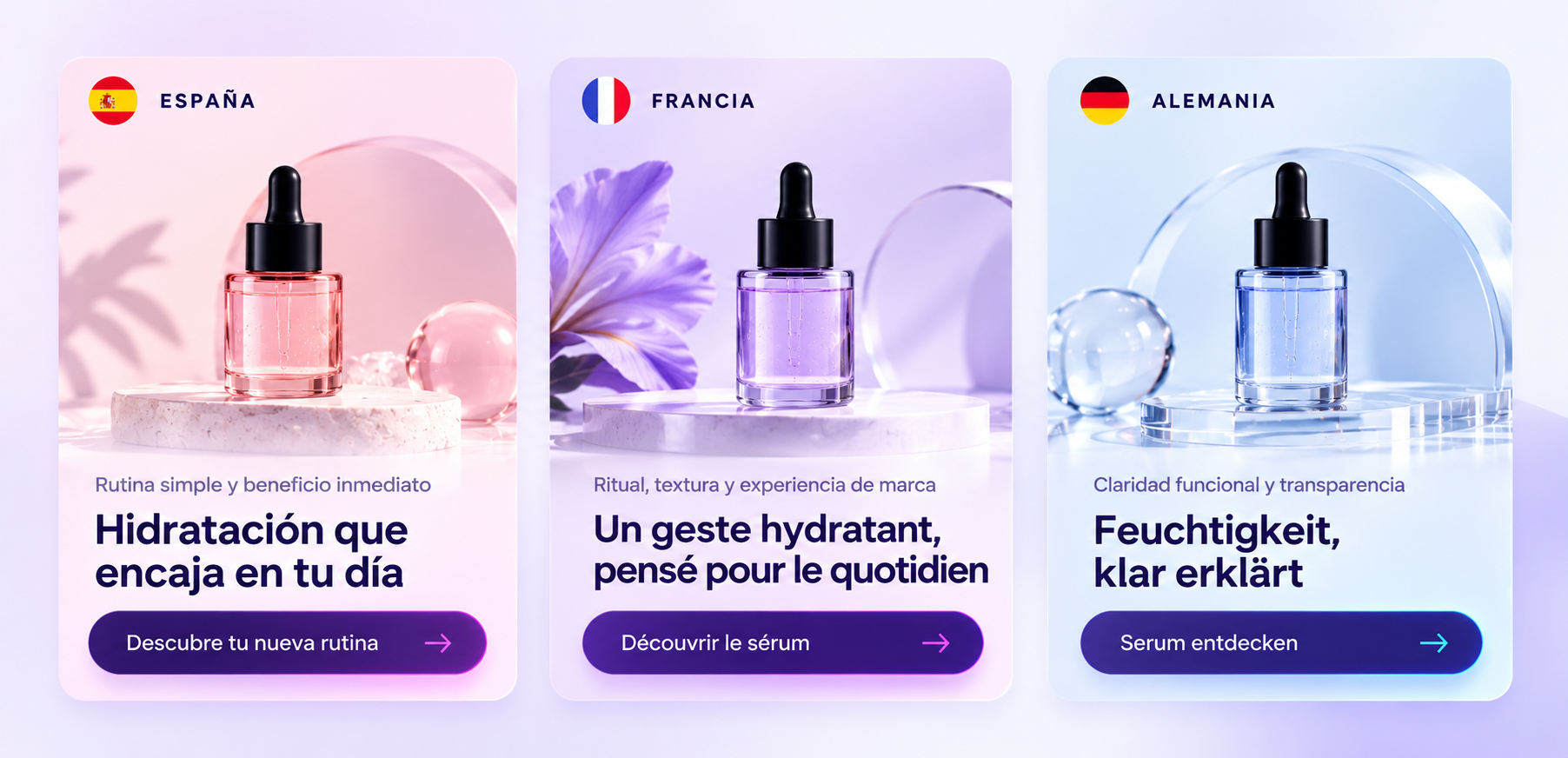
Subject: Your skin needs hydration. Your routine doesn't need to get complicated. Preheader: A lightweight serum to use every morning and every night. Hero: Hydration that fits into your day. Body: A lightweight texture, a simple step, and a 15% launch discount for 72 hours. CTA: Discover your new routine
What has been localized: The prominence of technical language is reduced, and the focus is placed on ease of use, routine and immediate benefit. The offer appears early and the CTA avoids sounding overly aggressive.
France: strengthen product experience and brand perception
Working hypothesis: In this French segment we want to test whether a more sensory and editorial narrative improves the response compared to a purely functional version. The product does not change; changes the message hierarchy.
Subject: A new gesture of hydration for your everyday life Preheader: A light texture, designed to accompany your routine. Hero: Un geste de soin, chaque jour. Body: A light formula that is easy to integrate into your routine, with -15% for 72 hours for its launch. CTA: Discover the serum
What has been localized: The campaign places less emphasis on "buy now" and more on discovery, ritual, and experience. The language becomes more editorial without introducing new claims or changing the product promise.
Germany: prioritize clarity, information, and control of the promise
Working hypothesis: For this audience, we want to test a more explicit and functional version, where the user quickly understands what the product is, how it fits into their routine, and what the promotion is.
Betreff: Daily moisture. Klar in der Anwendung. Preheader: Leichtes Serum für deine tägliche Pflegeroutine. Hero: Feuchtigkeit, klar erklärt. Body: Leichte Textur für die tägliche Anwendung. Zum Launch erhältst du 72 Stunden lang 15 % Rabatt. CTA: Discover serum
What has been localized: Aspirational language is reduced, information is organized, and the relationship between product, use, and offer is made explicit. Again, this is a communication hypothesis that needs to be validated with market data.
International marketing and localization: The difference lies not in the language, but in the editorial decision
Element
Spain
France
Germany
Angle
Simplicity and routine
Experience and discovery
Clarity and function
Priority benefit
Easy to integrate
Care experience
Clear use and proposition
CTA
Discover your new routine
Discover the serum
Discover serum
What to test
Benefit vs. discount
Editorial vs. functional
Brief information vs. detailed
How to localize an AI-powered email marketing campaign for different international markets
1. Define a master campaignBefore using AI, define your objective, offer, product facts, brand tone, and main CTA. The master campaign is the common reference point.
2. Research each marketAnalyze competitors, language used in the category, objections, common promises, business calendar, applicable regulations, and service expectations.
3. Formulate hypotheses, not stereotypesLocalization starts with questions that can be validated: Does a more functional message work better? Should the discount appear in the subject line? What proof of trust does this audience need?
4. Use AI-powered email marketing to generate variationsRequest market-controlled versions: subject, preheader, hero, body, and CTA. The AI must respect the product's facts and explain what it has adapted.
5. Connect email and destinationLocalization fails if the email is in French but the landing page, price, or checkout page are not. The experience must continue after the click.
6. Measure by marketDon't compare countries as if they were the same segment. Compare variations within each market and learn what factors explain the improvement.
5. What to measure to know if the localization is working
The open rate can serve as a secondary signal, but localization should be evaluated primarily in terms of behavior and business. Mailchimp has observed that segmented campaigns achieve more interaction than non-segmented ones, and its analyses link the relevance of the message with better results. HubSpot also places segmentation and personalization among the most effective uses of email marketing.
CTR by version and market.
Conversion rate after the click.
Revenue per recipient or per send.
Average order value where applicable.
Cancellations and complaints: a sign of lack of relevance.
Subject line, hero, and CTA performance through A/B testing.
Consistency between the localized version of the email and the destination landing page.
To identify which version drives visits to the website, tag the links with campaign parameters in Google Analytics. In this practical case, we can use utm_campaign to identify the launch and utm_content to distinguish variants such as fr_editorial or fr_funcional. This will allow us to analyze separately the traffic coming from each approach, provided that the website measurement is correctly configured.
Example of a correct test: in France, compare an editorial version versus a functional one while maintaining offer, audience and delivery time. The goal is to isolate the effect of the communication approach, not to compare France against Germany.
AI-powered email marketing in international marketing: how to maintain brand identity in different markets
One of the main challenges of international marketing is adapting communication without making the brand seem different in each country. Good localization should not transform the company’s personality, but rather find the most appropriate way to express it in each context.
Here AI-powered email marketing can be especially useful. Working from a master campaign allows you to establish a common reference point for tone, message, value proposition, and objectives. From that base, versions adapted to different markets can be created without losing the elements that make the brand recognizable.
For example, a brand can always maintain a friendly tone, be visually clean and focused on concrete benefits, but adapt the way those benefits are presented. In one market, it may be more effective to develop the argument in a more descriptive way; In another, use shorter and more direct messages. Adaptation changes the execution, not the essence.
So that AI-powered email marketing maintains that consistency, it is advisable to define brand rules beforehand: Expressions that must be preserved, terms that must not be used, permitted claims, level of formality, message structure, and elements that must never be modified.
This is especially important when an international marketing strategy begins to expand to several countries. Without clear rules, each new campaign can deviate slightly from the original positioning, resulting in fragmented communication.
AI should therefore be used as a tool to expand the team's capabilities without losing control over the content. The goal is not to create a different voice for each market, but to ensure that the same brand feels natural, consistent, and relevant in all of them.
Localization errors in AI-powered email marketing for international markets
Translate word by word: The result may be grammatically correct but commercially unconvincing.
Changing the tone without a hypothesis: Localizing does not mean "making it more creative"; Every change must respond to a market reason.
Inventing claims with AI: AI can reframe facts, but it should not create benefits, certifications, or features that the product does not have.
Maintain the same offer in all countries: Currency, shipping, thresholds, dates and conditions can cause a campaign to lose relevance.
Forgetting the landing: The user does not perceive localization as an isolated piece. Email, web and checkout form a single experience.
Using cultural clichés: "Germans are rational" or "the French are aspirational" is not a strategy. These are simplifications that should be replaced by research and testing.
Email marketing with AI and international marketing: personalization and localization are not the same thing
In an AI-powered email marketing strategy, personalizing and localizing a campaign are two different processes. Personalization adapts the message to user characteristics, such as their behavior, interests, purchase history, or the stage of the funnel they are in. Localization, on the other hand, adapts the campaign to the market context: language, cultural references, commercial arguments, offer, currency, service expectations and way of presenting the product.
This difference is especially important in international marketing. A campaign can be perfectly personalized for a repeat customer and, at the same time, be poorly localized if it uses an unnatural tone, displays a promotion that does not correspond to their country, or directs the user to a shopping experience designed for another market.
The true potential of email marketing with AI appears when both layers are combined. A brand can start with a global campaign, localize it for France, and within that French version, create different messages for new users, repeat customers, or inactive buyers. Adaptation then ceases to be carried out solely by language and begins to respond to both the market and the customer’s moment.
In international marketing, this combination helps avoid one of the most frequent mistakes in global campaigns: treat all users in a country as a single group. The market provides context, but individual behavior remains relevant. The strategy must decide which elements depend on the country and which depend on the relationship that each person maintains with the brand.
Therefore, using AI-powered email marketing should not mean generating a single version per language. AI can help build different combinations of market, audience, and funnel stage, provided there is a prior strategy that determines what needs to change and why.
How to adapt the customer journey to each market
The localization of a campaign should not be analyzed as an isolated action. As part of an international marketing strategy, the user may receive different emails before making a purchase: welcome, product presentation, cart recovery, launch, promotion, after-sales service, or reactivation. They are all part of the same customer journey and should maintain consistent logic within each market.
AI-powered email marketing allows you to adapt that journey without having to build each international sequence from scratch. A company can first define the global journey and then localize each touchpoint by country, maintaining the commercial objective but adapting how it is communicated.
For example, the first email in a sequence can focus on building trust, the second on explaining the product, and the third on driving conversion. That structure can be maintained in Spain, France and Germany, but the hierarchy of the arguments, the level of detail, the confidence tests or the way of presenting the CTA can vary depending on the hypotheses that are to be validated in each market.
In international marketing, this perspective is more useful than translating emails one by one, because it allows you to analyze the entire experience. If a brand adapts a product launch but leaves abandoned cart or after-sales emails untranslated, the user receives messages with different levels of adaptation and the experience loses consistency.
AI-powered email marketing can help scale these sequences, while maintaining brand guidelines and generating variations for each market. In this way, localization ceases to be a one-off task and becomes a permanent layer of the CRM and automation strategy.
For a company that operates in multiple countries, the goal shouldn't be to have more translated emails, but to build journeys that seem specifically designed for each market.
International marketing and email marketing with AI: how to turn each campaign into knowledge about the market
One of the biggest advantages of AI-powered email marketing within an international marketing strategy is that every campaign can become a source of learning. Localization is not just about creating a different version for each country, but also about using the results to understand which messages, benefits, and arguments work best in each market.
The Nébula Skin case makes this clear. If in France an editorial version is compared with a more functional one, the test result provides information that can be used in subsequent campaigns. If in Germany a version that clearly explains the use of the product performs better than one focused on the discount, that information can also be incorporated into future content decisions.
Thus, AI-powered email marketing allows for iterative work. The first version is based on a hypothesis; the data shows how the user responds; and the next campaign uses that learning to improve the message.
Within international marketing, this process has special value because it reduces dependence on cultural intuitions or generalizations. Instead of assuming how a brand should communicate in a country, the team progressively builds its own knowledge about that market.
Over time, a company can create a country-specific learning base that gathers which topics generate the most clicks, which benefits spark the most interest, which CTAs work best, which promotions convert, and which arguments build trust. This information can then be used to improve new campaigns, product pages, ads, or commercial content.
AI accelerates the generation of variants, but data determines which version deserves to be kept. Therefore, a mature AI-powered email marketing strategy should combine generation, localization, experimentation, and continuous learning.
The result is an international marketing strategy that is increasingly less based on assumptions and more supported by the actual behavior of each market.
How MIA fits into an international marketing strategy
The value of a solution like MIA should not be explained as "translating emails with AI". The most distinctive positioning is helping marketing teams work on adapting content for different markets with more expertise and less manual work.
Applied to email marketing with AI, the ideal flow would be: master campaign → market context → message adaptation → review → test → learning. In this way, the team maintains the global brand strategy, but avoids sending exactly the same campaign to all countries.
Key idea for closing: An international campaign should not seem translated. It should seem as if it was created for the person who receives it.
Frequently asked questions about email marketing with AI and international marketing
AI-powered email marketing: what is the difference between translating and localizing a campaign?
Translating changes the language. Localize to adapt the message to the market: tone, priority benefit, offer, CTA, references, currency, trust signal, and post-click experience.
AI-powered email marketing: Can it localize a campaign automatically?
It can speed up the creation of variants and detect adaptation opportunities, but it needs market context, brand boundaries, and review. Automating without context increases the risk of generic or unnatural messages.
International marketing: Which parts of an email should be adapted for each country?
Subject, preheader, hero, sales pitch, body, offer, CTA, images when they provide context, currency, conditions and destination landing page.
International marketing: How can you tell if a localized version works better?
Using A/B testing within the same market and measuring clicks, conversion, revenue, and churn. The comparison should keep offer, audience, and send time constant whenever possible.
How does AI-powered email marketing help an international marketing strategy?
Yes, especially for scaling campaign adaptation and generating market-specific variations, provided that AI works on a localization strategy and does not replace local research or review.
Black Friday 2026 campaigns: how to adapt them with AI to sell in different countries
Would your Black Friday campaign work the same in Spain, France, Germany, and the United Kingdom? You can offer the same product and the same discount, but that doesn't mean your buyers will search, compare, or decide in the same way. A perfectly understandable offer can go unnoticed if it uses the wrong words, fails to address local concerns, or conveys a benefit of little relevance.
Black Friday 2026 is on Friday, November 27, and Cyber Monday is on Monday, November 30. For ecommerce brands operating in multiple countries, the challenge is not just about publishing more promotions: It consists of ensuring that each market finds, understands, and values the offer. In this guide you will see how to combine artificial intelligence and international SEO to adapt campaigns, with an example applied to four countries and a methodology you can use from today.
Black Friday 2026: an international opportunity that requires preparing the content beforehand
The international dimension of the campaign is already tangible. According to Shopify, 16% of global orders registered by its ecosystem during Black Friday–Cyber Monday 2025 were cross-border. That doesn't mean the same percentage applies to every store; it does confirm that peak demand dates can also generate sales outside the home market.
The calendar matters. If you wait until November 27 to create a localized landing page, you'll be too late to research searches, review versions, resolve technical errors, and accumulate relevance signals. In October, it is advisable to identify priority markets, products, and pages; In November, finish the adaptations, publish them in time, and review the shopping experience.
Why the same campaign shouldn't be copied in every country
Translating "Up to 30% off" into four languages may solve a linguistic need, but not the entire business strategy. The user may search for a product category using a different term, need specific information about delivery times, or prefer that the ad explain which items are included. The problem is not the language itself: is assuming that the search intent is identical.
Before creating the copy, distinguish three layers. The first is the demand: which words each market uses and which ones indicate purchase intent. The second is the message: What benefit does the user need to understand in order to consider the offer? The third is experience: currency, availability, shipping, returns, and conditions consistent with the campaign promise.
For example, a cosmetics brand may want to sell the same serum in Spain and Germany. It shouldn't be limited to simply changing the headline language: You need to check which combination of category, attribute, and offer is in demand on each search engine, and what information the landing page needs to turn that search into an informed decision.
One campaign, four markets: How to adapt Black Friday with AI
Let's imagine a fictional personal care product brand that is preparing to launch a real and verifiable promotion for four countries. It maintains the same catalog but adapts the inbound content to each market. The messages in the table are editorial sketches, not validated keywords or claims about national preferences.
Market
Example message
What needs to be validated
Spain
Black Friday: Discover your personal care favorites
Product terms and searches related to the offer
France
Black Friday: retrouvez vos soins favoris à prix réduit
Natural copy, category language, and conditions
Germany
Black Friday: Offers for your care favorites
Local keyword, product information, and clarity of the promotion
United Kingdom
Black Friday deals on your favorite skincare products
Use of GBP, delivery times, and search terms
What really changes? Not the product nor necessarily the discount percentage. The words that connect a search to a page change, as does the context that presents the benefit and the details that need to be explicit. AI can speed up early drafts, but the final selection should be supported by local search data, actual business rules, and a quality review.
How to prepare a Black Friday ecommerce campaign with AI, step by step
1. Investigate search intent in each market
Start with categories that have margin, availability, and international sales potential. For each country, analyze category terms, combinations with Black Friday, product searches, and pre-purchase questions. Compare volume, difficulty, intent, and pages that already appear in the results. Do not accept a literal translation of the Spanish keyword: Two equivalent expressions can have different demands and nuances.
The deliverable for this phase should be a simple matrix with market, main local keyword, search intent, destination URL, and type of missing content: promotion landing page, collection, product page or FAQ.
2. Adapt the headline, sales pitch, and CTA
Use a unique brand brief: public, approved offer, legal restrictions, tone, demonstrable benefits, and terms that must not be modified. Based on that brief, the AI can suggest headlines, meta descriptions, category descriptions, or emails by language. Then compare the proposals with SEO research and eliminate phrases that sound generic or promise more than the business offers.
The goal is not for the four versions to be different by necessity, but for each one to respond well to the intention of its market without losing brand recognition.
3. Coordinate the landing page, email, and ads
An international campaign loses strength if an ad mentions a promotion that the landing page doesn't explain, the email uses a different date, or the button leads to a store in another country. Define a central message and adapt the necessary pieces: SEO title, H1, supporting text, featured product pages, CTAs, email subject lines and advertising copy. Maintain a single source of truth for discounts, dates, and conditions.
Don't confuse content adaptation with technical campaign management: Reviewing budgets, configuring audiences, applying discounts, or synchronizing inventory requires tools and processes specific to ecommerce.
4. Publish pages prepared for international SEO
Ensure that each version of the campaign has an accessible URL, localized metadata, internal links from relevant categories, and consistent navigation. When equivalent versions exist by language or region, correctly implement hreflang annotations and review the canonical criteria for each page, following Google’s documentation on localized versions.
Not indexing a landing page, publishing its canonical link to the homepage, or automatically redirecting users and crawlers without an alternative can prevent a good campaign from being visible. Also check mobile performance, availability, and checkout: Attracting traffic isn't very useful if the purchasing process fails.
5. Measure by market and use the results to improve
Analyze organic impressions and clicks by country, CTR, sessions to campaign pages, conversion rate, and revenue. Separate organic traffic from paid and email traffic to avoid attributing results to a single channel. Also compare new queries, visited products, and checkout abandonment. The useful decision is not just “which country sold more?”, but “which content hypothesis worked and what should we adjust?”.
SEO and AI assistants: a second chance at discovery
Black Friday SEO no longer lives solely on the traditional search results page. According to Adobe Analytics, traffic from generative AI tools to US online stores increased by 693.4% year-over-year during the November–December 2025 holiday season. The source itself warns that the starting point remains limited. It's not about promising sales by appearing in an assistant, but about recognizing a new avenue of discovery.
To make it easier for search engines and assistants to understand a product, the priority remains to offer useful, verifiable, and well-structured information: clear names, attributes, uses, availability, price and conditions. A localized page that accurately answers the buyer’s questions is more valuable than text bloated with repetitions of “Black Friday 2026.”
If your brand operates in multiple languages, it's also important that this information is consistent across versions. International GEO can complement SEO, but no tool guarantees that a brand will appear in generative responses.
Email marketing for Black Friday 2026: How to customize your campaigns by market
Email marketing is an important channel within a Black Friday ecommerce strategy, both to communicate promotions and to win back customers interested in certain products.
In an international campaign, it is not enough to send the same email in different languages. The subject line, preheader, and call to action must respond to the market context and maintain consistent communication with the offer.
Example: a Black Friday campaign tailored to four countries
Let's imagine a cosmetics brand that is preparing a promotion of 30% off on a selection of products. The offer is the same for all markets, but the marketing team can test different ways of communicating it.
Market
Example email subject line
Spain
Black Friday 2026: Your favorites with a 30% discount
France
Black Friday: -30% on a selection of skincare products
Germany
Black Friday: 30% Rabatt auf ausgewählte Pflegeprodukte
United Kingdom
Black Friday: 30% off selected skincare products
These examples are editorial proposals, not messages validated through search data or performance tests. Before using them, their naturalness, the conditions of the promotion, and their suitability to each market must be checked.
How to organize an email sequence for Black Friday
An effective campaign should not be limited to a single mailing. You can organize communications in three stages:
Before Black Friday: to generate excitement, showcase featured products, and communicate when the promotions will begin.
During Black Friday: advertise active offers, highlight their conditions, and direct users to the corresponding purchase pages.
During Cyber Monday: Communicate promotions that are still valid and provide a final purchase opportunity, without using misleading urgency messages.
With MIA Genius, marketing teams can start with an original email and prepare versions adapted to different languages and markets, maintaining the brand tone and taking into account the cultural context and search intent where appropriate.
The result is more agile content production, with time to review the quality of each message and evaluate its performance through A/B testing.
Black Friday 2026 advertising: How to create international ads with AI
Google Ads and Meta Ads campaigns can help ecommerce businesses attract shoppers during Black Friday 2026. However, to sell in different markets it is important to adapt advertising messages to the searches, needs and characteristics of each audience.
Example: Two advertising approaches for the same offer
Let's imagine that an online cosmetics store is preparing a Black Friday campaign with a 30% discount on certain products.
Instead of using a single ad, you can try two different approaches:
Ad A: highlight the savings
Account holder: Black Friday 2026: save 30%.
Description: Discover our selection of discounted cosmetics during Black Friday.
CTA: View offers.
Ad B: highlight the product
Account holder: Your favorite beauty products, now 30% off.
Description: Discover the must-haves from our Black Friday collection and find your favorites.
CTA: Explore collection.
Both ads communicate the same promotion, but use different arguments. The first one emphasizes savings, while the second one focuses on products.
How to adapt ads to different markets
To launch these campaigns internationally, it is necessary to review the keywords used in each country, adapt the texts to the language, and verify that the landing pages display the correct offer.
It is also important that the ads respect the character limits, the requirements of each platform, and the commercial terms of the promotion.
With MIA Genius, marketing teams can streamline the creation of different versions of advertising copy for each market, while maintaining consistent brand communication.
A/B testing then allows you to compare ad performance and optimize campaigns based on indicators such as CTR, conversions, and cost per acquisition.
Six mistakes that can ruin an international Black Friday
Copying the same keywords between countries without checking how each product is actually searched for.
Literally translating banners, subject lines, and calls to action without checking their naturalness.
Displaying currencies, shipping costs, or return policies that do not correspond to the market.
Launching landing pages after the campaign has already started, without time for indexing and testing.
Using artificial urgency, confusing discounts, or inaccurate price references.
Analyzing the overall result without identifying the markets and channels that actually convert.
This fifth mistake is not a minor detail. A European Commission investigation published in March 2026 found that 30% of 314 online stores examined incorrectly indicated discounts. In the EU, price reduction communications must comply with applicable rules on the previous price, including the general reference to the lowest price of the previous 30 days. Review the exceptions and specific regulations before publishing promotions in each country.
A practical calendar to be on time for Black Friday 2026
Timing
Priority
October · weeks 2–3
Select markets, products, and keywords; prepare the brief and the landing page map.
October · Week 4
Create localized versions; review tone, SEO, prices, and commercial terms.
November · weeks 1–2
Publishing and validating URLs, indexability, hreflang, linking, and mobile experience.
November · weeks 3–4
Activate and coordinate channels, monitor searches and conversions, and correct issues.
November 27–30
Measure Black Friday and Cyber Monday results by country, product, and channel.
This is a tentative calendar: A store with thousands of products, several CMSs, or new integrations will need to get ahead on tasks. The legal review, final price, and availability must be finalized before the offer is published.
How MIA can help you adapt content for Black Friday 2026
The starting point for a scalable campaign is not four independent translations: It is a clear strategy with a common brand message and relevant versions for each market. MIA combines cultural adaptation, search intent, and international SEO to help marketing teams create content in different languages without losing consistency.
In practice, you can start with an approved campaign text, define priority markets, and use MIA to create adapted versions that you will then review with your local keywords, business data, and editorial criteria. This way, the team spends less energy rewriting texts from scratch and more on deciding what message each audience needs.
A Black Friday campaign doesn't have to sound the same in every country. The best starting point is to know what each market is looking for and build content capable of responding to it.
Are you preparing an international campaign? Try MIA for free and start adapting your content with AI and an SEO focus.
Frequently asked questions about Black Friday 2026 and international ecommerce
When is Black Friday 2026?
Black Friday 2026 will be on Friday, November 27. Cyber Monday will be held on Monday, November 30th. It is advisable to prepare the content, landing pages and their technical review weeks in advance, especially when the store sells in different languages and markets.
How to prepare a Black Friday campaign for multiple countries?
Select priority markets and products, research local keywords, adapt the promotional message, and create pages with accurate commercial information for each country. Review links, indexing, currency, logistics, and mobile shopping. During the campaign, measure traffic and conversions by market to improve each version.
How does AI help adapt ecommerce campaigns?
AI can accelerate drafts of headlines, landing page copy, emails, and localized descriptions, and help maintain brand consistency. It does not replace keyword validation, naturalness checks, price verification, or business decisions. Its usefulness increases when it works from a well-defined brief.
Why is international SEO important during Black Friday?
Because consumers in each market may use different expressions to find the same category or promotion. International SEO connects those searches with relevant pages in the appropriate language and context. Without local research and a proper technical architecture, a translated campaign may have little organic visibility.
Is it enough to simply translate a Black Friday landing page?
No. A linguistically correct version may not meet the search intent or local purchasing expectations. It is advisable to adapt titles, keywords, descriptions, CTAs, and commercial information, and to verify that all elements link to the actual offer and the conditions valid for that market.
AI-powered localization: How to use AI for businesses operating in international markets
Entering a new country has always required more than just translating a website. Words, searches, service expectations and the way of comparing alternatives change. That’s why a linguistically correct translation may be commercially irrelevant. The message is understood, although it doesn’t necessarily connect, position or convert.
AI-powered localization allows you to address this challenge at a scale that was previously reserved for organizations with large international teams. When applied correctly, AI for businesses helps to analyze the context of each market, adapt content, maintain brand identity, and accelerate multilingual production. However, technology does not eliminate the need for strategy. To compete in international markets, each version must respond to a local search intent and a specific commercial reality.
The World Trade Organization points out that AI can reduce trade-related costs, improve productivity, and expand access to global markets. In terms of content, this opportunity materializes when automation ceases to be a quick translator and becomes a governed localization system: with objectives, reliable sources, quality criteria, risk-proportional review, and business metrics.
What does localizing with AI mean for businesses in international markets
Translation consists of transferring meaning from one language to another. Localization involves adapting an experience so that it feels natural and useful in a specific market. The difference affects vocabulary, but also currencies, units, examples, date formats, legal references, calls to action, images, channels, and sales arguments. Two countries that share a language may need different versions because they search, buy, and evaluate differently.
AI for businesses expands this process by working with large volumes of information and applying consistent instructions. It can transform a landing page, an article, an email sequence, or an entire catalog using a style guide, a glossary, product data, and audience profiles. It can also propose variants, detect terminological inconsistencies, and prioritize the fragments that require human validation.
This means that localization no longer has to start when the original content is finalized. It can be integrated from the planning stage. A team can design a master piece ready to adapt, define which elements are global and which should change by country, and coordinate the launch of multiple versions. The result is a more continuous process, with less duplication and a greater capacity to learn from each market.
Even so, language is just one layer. An effective strategy must preserve the brand’s core promise while also allowing the expression of that promise to change. In international markets, consistency does not mean literal uniformity. This means that the same identity is recognized even though the message responds to different local motivations.
Why AI for businesses is transforming international markets
The first change is operational. A traditional model requires chaining together writing, translation, review, SEO, approval, and publication for each language. As content grows, so do emails, spreadsheets, versions, and waiting times. AI can reduce some of that friction, reuse approved decisions, and prepare contextualized drafts so that people can focus on the points with the greatest impact.
It also improves consistency. When there are clear rules, an AI system can apply approved product terminology, tone, and messaging to thousands of pieces. This common foundation prevents each provider from interpreting the brand in a different way. Human review remains decisive in high-visibility campaigns, sensitive messages, legal claims, or technical content, but it is no longer applied identically across the entire inventory.
In practice, this means adopting a hybrid model. AI brings speed, comparison, and scale. Local specialists contribute cultural perspective, sector-specific knowledge, and accountability. The value lies in the coordination between the two, especially when decisions and corrections are documented to improve subsequent versions.
What content does AI adapt for businesses in international markets?
Localization should follow the actual customer journey. Adapting a campaign is of little use if the landing page, the form, or subsequent messages revert to the original language. The experience loses continuity precisely when the user needs confidence. Therefore, it is advisable to map the touchpoints and decide what level of adaptation each one requires.
In marketing, priority is usually given to service pages, categories, articles, ads, emails, and sales materials. An e-commerce site includes product pages, measurements, shipping, returns, reviews, and transactional messages. In SaaS, the interface, onboarding, knowledge base, and support are part of the product and influence activation. In B2B, use cases, comparisons, technical documentation, and credibility tests often carry as much weight as brand messaging.
The key is to classify the content by value and risk. A repetitive, informative description can be automated and controlled through sampling. A cover, a brand campaign, or a contractual condition requires expert review. This segmentation avoids two extremes: Manually reviewing every word reduces the advantage of scale, while publishing without oversight exposes the company to errors of meaning and reputation.
A typical example would be a Spanish SaaS company entering Germany. The local version may need to emphasize security, integrations, and compliance rather than ease of use. AI can reorganize the hierarchy, adapt examples, and maintain the approved vocabulary. A specialist then validates that the claims, tone, and expectations are appropriate. This is not a story attributed to a real company, but a representative scenario of how the message changes depending on the market.
AI for businesses and SEO in international markets
A keyword does not travel intact between countries. A literal translation may have low volume, a different intent, or an unexpected semantic competitor. Therefore, international SEO starts with local research: What questions does the audience ask, what formats dominate the results, what vocabulary does the sector use, and what level of knowledge does the user demonstrate?
AI can group queries, compare intents, generate structures, and adapt drafts, but decisions must be supported by target market data. The content also needs differentiation. Publishing dozens of almost identical pages, only changing country names, hardly creates a relevant proposition. Each version should incorporate examples, objections, commercial information, and links that are useful to that audience.
The technical layer completes the editorial work. Google Search Central recommends using different URLs for language versions and indicating their relationships with hreflang. It is also advisable to keep navigation and main content in a clear language, offer an accessible selector, and review canonicals, sitemaps, and indexing. A great adaptation will not generate results if the search engine cannot discover or correctly interpret your version.
MIA Genius is based precisely on the union between content adaptation, transcreation, and international SEO. The approach is relevant because a localized page must pass two tests: respond to the right search and persuade when the visit arrives. Positioning without converting wastes demand. Converting without visibility limits scale.
How to measure AI for businesses in international markets
Counting words produced is useful for observing capacity, but it does not demonstrate impact. A useful dashboard should connect production, quality, visibility, and business. In operations, it is advisable to measure time to publication, cost per piece or market, number of revisions, and reuse of approved content. In terms of quality, errors can be recorded by category, terminological consistency, and the percentage of pieces that require in-depth intervention.
In SEO, relevant signals include impressions, clicks, CTR, positions, new keywords, indexed pages, and organic traffic by country. They should be analyzed by market, not just as a global total. An overall improvement can mask the fact that one region is growing while another publishes pages that do not meet demand.
Finally, measurement must reach the business: conversion rate, qualified leads, activation, order value, opportunities, and acquisition cost. Not all pieces are intended to drive an immediate sale, but each one should have a defined role within the journey. Attribution will be imperfect, although a stable combination of indicators makes it possible to compare markets and decide where to invest.
Learning occurs when those results modify the system. Queries that attract customers fuel new content, frequent corrections update the glossary, and markets with the best response receive greater depth. The upshot is clear: Localization ceases to be a uniform cost and becomes an investment portfolio that can be prioritized based on evidence.
AI-powered localization for businesses in international markets by sector
Localization does not provide the same value in all business models. Each sector has different touchpoints, risks, and conversion criteria. A useful strategy must recognize these differences before deciding what content to automate, what contextual information AI needs, and where to focus specialized review.
In e-commerce, the priority is usually on categories, product pages, attributes, sizes, payment methods, shipping, and returns. The adaptation must respond to how people in each country search and compare. It also has to preserve the accuracy of the catalog, because a persuasive description loses all its value if it contains an incorrect measurement, material, or condition.
In SaaS, the localized experience continues within the product. Website, demo, interface, onboarding, help center, and lifecycle communications should use consistent terminology. For a B2B company, on the other hand, use cases, technical documentation, integrations, compliance, and arguments that help justify the decision to various stakeholders tend to carry more weight.
Premium brands and professional services face another challenge: to preserve perception, authority, and nuance. An overly literal version can sound rigid, while a generic adaptation can reduce differentiation. In these cases, transcreation and local review carry more weight. Technology speeds up the work, but editorial judgment protects the positioning that the brand has built.
AI-powered localization plan for businesses in international markets in 90 days
A 90-day plan allows you to validate the model without turning internationalization into an indefinite project. During the first few weeks, the team must choose a priority market, define a primary conversion, and inventory the content that influences it. In this phase, the glossary, style guide, product sources, and review criteria are also prepared.
A limited pilot program may be developed between days 31 and 60. It is recommended to include pieces with different functions, for example a commercial page, informational content, and post-conversion communication. AI generates the adaptations, while SEO, business, and a person with local knowledge record corrections, questions, and decisions that can be reused.
In the final stage, the validated pieces are published and their real-world performance is observed. You need to check indexing, impressions, interaction, forms, lead quality, and operational load. Issues must be turned into concrete changes within the instructions, language assets, or approval process.
At the end of the 90 days, the company should be able to answer three questions: if there is demand, if the localized content generates a credible experience, and if the process can scale without losing control. With those answers, it's possible to expand inventory, incorporate another market, or correct the approach before investing more. The key is to scale after learning, not before.
MIA Genius as AI for businesses in international markets
For a company that already has good content in one market, the challenge shouldn't be to manually recreate it country by country. You should be able to maintain the strategy, adapt what changes, and publish quickly enough to learn. MIA Genius is presented as a multilingual platform developed by ATLS Global to create and adapt content to different languages, markets, and search intents.
Their proposal combines transcreation, cultural localization, and international SEO. This combination places the focus on content performance, not on literal equivalence. A landing page must maintain its commercial intent, an article must compete for local queries, and a product page must resolve the doubts that influence the purchase in that country.
This does not replace market choice, value proposition, or expert validation. Yes, you can make them more scalable by turning rules, context, and brand assets into a repeatable process. For teams, the advantage lies in reducing fragmented tasks and maintaining greater control over content published in multiple countries.
Internationalization works best when the brand thinks globally and executes with local sensitivity. With clear objectives, adequate data, risk-proportional review, and an infrastructure like MIA, AI for Business can transform existing content into a real basis for competing in international markets. It’s not about producing more languages. The goal is to create experiences that seem tailored to each market and, therefore, have a greater chance of generating trust, visibility, and growth.
Frequently Asked Questions about AI for Businesses in International Markets
How does AI for Business help companies enter international markets?
It allows you to research local language, adapt content, maintain brand consistency, and accelerate launches. It should be combined with market data and human review according to risk.
What content can AI localize for businesses in international markets?
You can adapt websites, landing pages, blogs, product sheets, campaigns, emails, interfaces, knowledge bases, and sales materials, with different controls depending on their impact.
How does AI-powered localization help businesses in international markets?
It allows for faster content adaptation, maintaining brand consistency, and better responding to the expectations of customers in each country.
How does AI help businesses with international SEO?
It helps to research search intent, create localized structures, adapt metadata, and produce relevant content for each country. The technical implementation must be completed with localized URLs and hreflang.
Can AI for businesses maintain brand tone in international markets?
Yes, as long as you have a style guide, approved terminology, reference examples, and clear instructions. Local review makes it possible to verify that the result preserves the brand’s identity.
Internationalization of companies: a practical guide to website localization
Entering a new market often seems simple on paper: select a country, translate the website, and start generating demand. However, when a company tries to repeat this process in multiple languages, the complexity grows rapidly.
Each new market adds keyword research, cultural adaptations, reviews, content versions, and coordination tasks. The marketing team begins managing scattered documents, external suppliers, and calendars that are moving at different speeds. Meanwhile, updating a global page requires reviewing all its international variants.
This is one of the main challenges of business internationalization. The problem is not just translating more content, but doing so quickly, consistently, and with local relevance, without multiplying costs or overloading the team.
Website localization must therefore become a scalable process. This involves combining strategy, International SEO, cultural adaptation, technology, and editorial control. Tools such as MIA allow this process to be accelerated through artificial intelligence, helping to transform original content into versions adapted to different languages and markets.
The challenge of internationalizing companies and localizing websites
International expansion introduces a tension that is difficult to resolve. On the one hand, the company needs to maintain its identity, its value proposition, and its core messages. On the other hand, each market demands content that seems created for its specific reality.
A literal translation can communicate the basic meaning of the text, but it does not guarantee that the page will respond to the searches, expectations, and objections of the local audience. The words used in Spain may not match those used in Mexico. An effective call to action in the UK may be too direct in another cultural environment. Even the way a price, a guarantee, or a success story is presented can influence trust.
The United States International Trade Administration differentiates between internationalization, regionalization, and localization. It defines localization as the adaptation of a website to target it specifically to a country and points out search engine optimization as part of the process necessary to reach international buyers. International Trade Administration
This means that a company doesn't just need multiple language versions. It needs relevant digital experiences for each market.
The problem arises when that customization depends entirely on manual processes. Localizing a page can be manageable. Localizing dozens of pages in five, ten, or twenty languages creates a very different workload. Without a proper system, each new market increases the time, cost, and likelihood of making mistakes.
Translation vs. website localization: What's the difference?
Translating a website and localizing it are not exactly the same thing. Translation transfers content from one language to another, while website localization adapts that content to the market, user behavior, and cultural context of the target country.
In a company's internationalization strategy, this difference is especially important. A page may be linguistically correct and yet not use the keywords that local users are searching for, present arguments that are not very relevant, or include calls to action that do not work the same way in that market.
Localization can affect vocabulary, tone, examples, units of measurement, cultural references, promotions, and also SEO.
For example, a company that wants to enter Germany should not limit itself to translating its Spanish content into German. Before publishing it, you should analyze how your audience searches, what terms they use, which competitors appear on Google, and which arguments generate the most trust.
Therefore, an effective localization strategy combines linguistic adaptation, international SEO, cultural context, and business objectives.
Why business internationalization stops scaling
Many organizations begin their international expansion with an improvised system. The team prepares the original text, sends it to a translator or provider, receives different files, and distributes them among marketing, SEO, and development.
This flow can work with little content, but it becomes difficult to manage as the volume increases. The main problems are usually the following.
Processes that are too slow
Each piece of content goes through numerous stages: extraction, translation, review, SEO optimization, approval, and implementation. If these tasks are performed consecutively and with different tools, publishing a campaign in multiple markets can take weeks.
The delay also affects updates. A change in the business proposal, the product, or the regulation requires localizing the related pages again. The more languages there are, the harder it is to keep all versions up to date.
Costs that increase with each language
In a completely manual model, each market adds hours of translation, coordination, review, and management. The cost increases almost in parallel with the number of versions.
This dynamic limits the ability to experiment. A company may forgo promising markets because it does not have the budget to produce all the necessary content, even if it does not yet know whether those markets will respond positively.
Overwhelmed marketing teams
Companies do not always have in-house specialists for every language. The core team ends up coordinating suppliers, resolving queries, and checking documents in languages they may not be fluent in.
The bottleneck is no longer in the strategy. It shifts towards production and coordination. Instead of analyzing results and improving campaigns, the team spends much of its time moving content between participants.
Inconsistencies in brand identity
When different providers work without a shared context, terminology, tone, and arguments can vary between markets. The result is a fragmented brand.
One version may communicate innovation, another may focus solely on price, and yet another may employ concepts that the company would never use in the original language. Although each text is correct on its own, the whole loses coherence.
Disconnection between translation and SEO
Translating a keyword is not the same as researching how a market searches. A linguistically correct expression may have a limited volume or respond to a different intention.
When optimization is done after translation, the SEO team may be forced to rewrite headings, metadata, and entire snippets. This creates duplication and further lengthens the process.
Common mistakes in the internationalization of companies and the localization of websites
A company's internationalization strategy can lose effectiveness if digital adaptation is limited to translating content. Website localization must take into account the market, search intent, and expectations of each audience. It is not enough to use the same keywords or replicate the same content in all countries, as each market searches, interprets, and responds differently.
Therefore, it is important to integrate localization with international SEO, adapt messages, tone, and calls to action, and analyze the results independently in each country. In addition, international versions must be kept up to date to reflect any changes in products, services, or brand messaging. In this way, localization becomes a strategic part of the internationalization process.
How to create a scalable website localization strategy
To scale, localization must no longer be managed as a collection of independent requests. It needs to function as a common system for producing, reviewing, approving, and updating international content.
The key is to separate strategic decisions from repetitive tasks.
The team must continue defining which markets have potential, which products it can offer, which audiences it wants to reach, and which value proposition is appropriate. The team must also validate the accuracy of sensitive content and verify that the final version correctly represents the brand.
However, some of the analysis and initial adaptation can be supported by automation. This makes it possible to generate versions more quickly and to focus human intervention on the points where it truly adds value.
A scalable model should include:
Complete and approved original content.
Clear information about the brand, the audience, and the objective.
Keywords researched for each market.
A common adaptation process.
A view that allows you to compare the different versions.
Review criteria based on content risk.
Clearly designated individuals responsible for approval and publication.
Metrics separated by language and country.
Not all content requires the same level of supervision. An educational blog post may undergo regular editorial review. A pricing page, a contract, or health-related content requires specialized controls.
Scaling does not mean eliminating human review, but using it in a proportionate and intelligent way.
International SEO and website localization: keys to entering new markets
Website localization must be accompanied by a strategy of international SEO. Adapting the language of a page does not guarantee that it can compete in the search results of the new market.
Before publishing an international version, it is advisable to analyze how the local user searches, which keywords they use, what their search intent is, and which competitors occupy the top positions.
An effective internationalization strategy for companies should work on at least four elements:
Keyword research by country, avoiding literally transferring the keywords from the original market.
Adaptation of titles, headings, and meta descriptions according to local search intent.
Cultural localization of the content, adjusting arguments, expressions, examples, and calls to action.
SEO measurement by market, analyzing positions, organic traffic, conversions, and the evolution of the localized pages.
In this way, the company does not simply create a website in several languages. It builds a digital presence ready to rank and compete in every new market.
How MIA solves the internationalization of companies and the localization of websites
MIA is a platform developed by ATLS Global to adapt digital content to different languages and markets. Its proposal combines transcreation using artificial intelligence and international SEO, so that the result is not limited to a word-for-word translation.
The tool organizes the process into a guided flow.
1. Incorporation of the original content
The user pastes into MIA the content they want to adapt. This could be a service page, an article, a business description, or other pre-prepared text.
According to the provided interface, each process supports content of between 1,000 and 5,000 characters. Working from a complete original text helps to preserve the context, objective, and main arguments during the adaptation.
2. Language selection
The team selects one or more target languages. The interface allows you to add new languages or remove those that are not needed before starting.
The platform communicates the ability to work with more than 50 languages. This allows you to prepare multiple versions from a single source, without manually repeating the workflow for each one.
Language is only one part of the decision. The team must indicate or be clear about which market it wants to target, because a version for Spain may need differences compared to one aimed at Mexico, even if both are written in Spanish.
3. Semantic analysis and SEO
At the start of the process, MIA analyzes the original content. The tool indicates that this analysis considers the semantic context, SEO, and keywords.
This phase allows us to interpret the purpose of the text before localizing it. Instead of replacing terms in isolation, the system works on the complete meaning and the elements that influence its organic performance.
For the team, this reduces the disconnect between translation and optimization. Both dimensions become part of the same adaptation flow.
4. Localization for each market.
After the analysis, MIA generates the versions corresponding to the selected languages. The platform uses transcreation to adapt the message to the new context without losing the intention of the original.
This is especially important on commercial pages. A benefit does not always have to be expressed in the same way in all countries. The localized version must retain the brand identity and, at the same time, feel natural to the new audience.
AI accelerates initial production. The team can dedicate more time to reviewing strategy, accuracy, and elements with the greatest commercial impact.
5. Comparison and editorial control
Once the process is complete, MIA displays the original content alongside the localized versions. The different languages appear organized in tabs, allowing you to switch between versions and compare them with the source.
This visualization offers a significant operational advantage. The team can check if essential messages have been preserved, review specific terms, and detect adjustments before publishing.
Localized content can also be edited from the interface. In this way, the AI's output does not automatically become a final version, but rather a basis over which the team maintains control.
6. Download and continuity of the process
After reviewing the content, the user can download it and continue with another piece. The flow is prepared to be repeated with new pages, articles, or materials.
This repeatability is fundamental for the internationalization of companies. The value lies not only in localizing content, but in having a method that can be consistently applied to an entire international strategy.
How to measure the success of an internationalization strategy
Process efficiency should be measured together with business performance. Producing more versions in less time adds value when those pages gain visibility, attract the right audience, and generate opportunities.
It is advisable to analyze each market separately using indicators such as:
Average time for localization and publication.
Cost per page and language.
Percentage of content that needs corrections.
Organic impressions and clicks.
Keywords positioned by market.
Leads and conversions.
Revenue attributed to the localized pages.
Performance of calls to action.
It is also important to collect qualitative information. Customer questions, sales objections, and identified terminological differences allow for improvements in subsequent versions.
Each market should function as a continuous cycle: research, localize, review, publish, measure, and optimize.
The internationalization of companies is not unlocked simply by adding languages to a website. It requires a system capable of maintaining local relevance, global coherence, and operational efficiency.
MIA offers a concrete solution to the content bottleneck. It analyzes the original, generates localized versions with an SEO focus, allows for comparison, and keeps the team in charge of editing and approval.
The result is a more agile way to approach website localization, test opportunities, and expand international presence without requiring resources to grow at the same pace as the markets.
Frequently asked questions about business internationalization and website localization
How does MIA help with business internationalization?
MIA analyzes original content, adapts it to the selected languages with an SEO focus, and allows you to compare, edit, and download each version.
What problems does MIA solve in business internationalization?
It reduces manual workload, speeds up production, improves consistency, and facilitates content creation for multiple markets.
Can MIA automate website localization in business internationalization?
MIA automates the analysis and initial adaptation. The team retains editorial control and must review the content according to its complexity and risk.
What content should be prioritized in business internationalization?
It's best to start with pages that combine local demand and commercial value, such as services, products, pricing, case studies, and content that already converts.
Why is SEO important for the internationalization of companies?
Because it allows you to understand how each market searches and adapt pages to terms and intents with real demand, beyond literal translation.
How does MIA help in the internationalization of companies?
MIA allows you to adapt content to different languages and markets by combining localization, AI-powered transcreation, and international SEO. The platform analyzes the original content, generates localized versions, and allows users to compare and edit them before publication.